Smart Contract Attacks Library
Explore smart contract vulnerabilities, attack vectors, and security exploits used by hackers and auditors.
Attack Classes
Click on any attack to learn more about it
Access Control Attacks
Access control vulnerabilities let unauthorized accounts execute privileged operations. OWASP ranks broken access control first in its 2025 Smart C...
Arithmetic Overflow & Underflow Attacks
Integer overflow and underflow attacks have drained over $1 billion from Decentralized Finance (DeFi) protocols and web3 projects. In April 2018, a...
Delegatecall & Call Injection Attacks
The Parity Wallet hack froze $150 million and showed that a single vulnerability can permanently destroy an entire protocol. In November 2017, an a...
Flash Loan Attacks
A flash loan attack uses uncollateralized, same-transaction borrowing to amplify a separate protocol weakness. The loan is not usually the bug: the...
Oracle Manipulation & Price Manipulation
On October 26, 2020, an attacker used price manipulation to extract $34 million from Harvest Finance in about seven minutes. The incident showed ho...
Reentrancy
Reentrancy is the classic smart contract vulnerability for a reason: it teaches one of the most important audit lessons in Web3 security. Every ext...
DAO Governance Attacks
DAO governance attacks manipulate voting power, proposal review, or execution controls to make a protocol authorize harmful actions. The $182 milli...
Frontrunning & Sandwich Attacks
Frontrunning attacks exploit the transparent nature of blockchain mempools to steal value from unsuspecting users. Imagine playing a game of poker ...
Phishing Attacks
Web3 phishing attacks target the person approving a transaction rather than a flaw in contract code. A malicious signature can grant an attacker pe...
DOS Attacks
Denial of Service (DOS) vulnerabilities prevent users or administrators from completing an operation. In smart contracts, a blocked withdrawal or s...
Replay Attacks
A smart contract replay attack reuses a valid signature or transaction to execute an action more times, on more contracts, or on more chains than t...
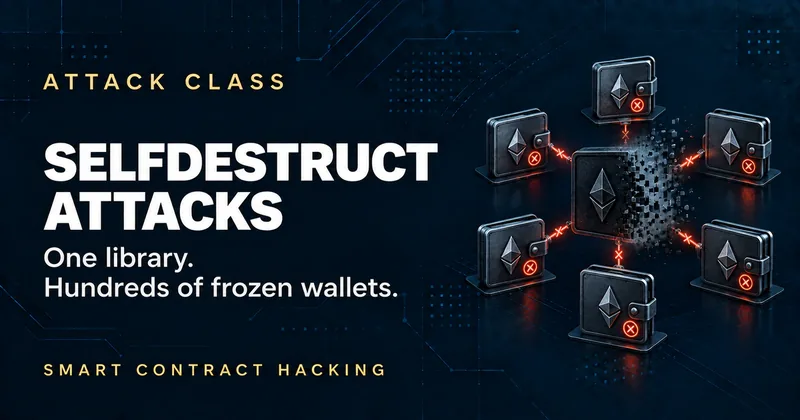
Self-Destruct Attacks
In November 2017, a GitHub user triggered an unprotected call inside a shared library contract, freezing 513,774 ETH. More than 300 Parity multisig...
Sensitive On-Chain Data
Yes. Ethereum smart contract storage variables are publicly readable by anyone, even when marked in Solidity. The modifier controls which Solidity ...
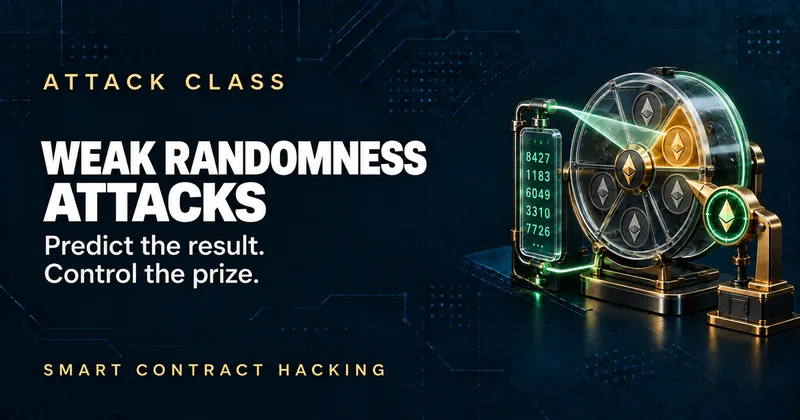
Weak Randomness Attacks
Lotteries, NFT mints, games, and token distributions may depend on outcomes that participants cannot predict or influence. A deterministic blockcha...
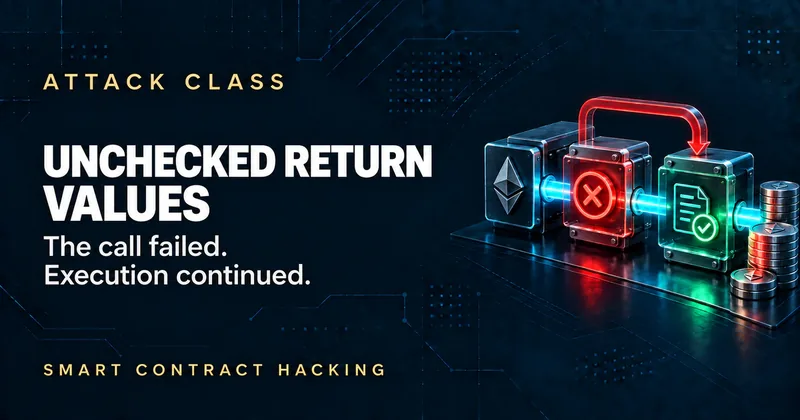
Unchecked Return Value Attacks
An unchecked return value lets a contract continue after an external operation fails. The code may compile and execute without reverting even thoug...
Ready to Master Smart Contract Security?
Learn to identify and exploit these vulnerabilities hands-on in the Smart Contract Hacking course.

Want to go deeper? Explore our security articles →