
Flash Loan Attacks
How the attack works and how to prevent it





A flash loan attack uses uncollateralized, same-transaction borrowing to amplify a separate protocol weakness. The loan is not usually the bug: the exploitable condition is often a manipulable spot price, broken share accounting, unsafe liquidation math, or voting power measured from a current balance.
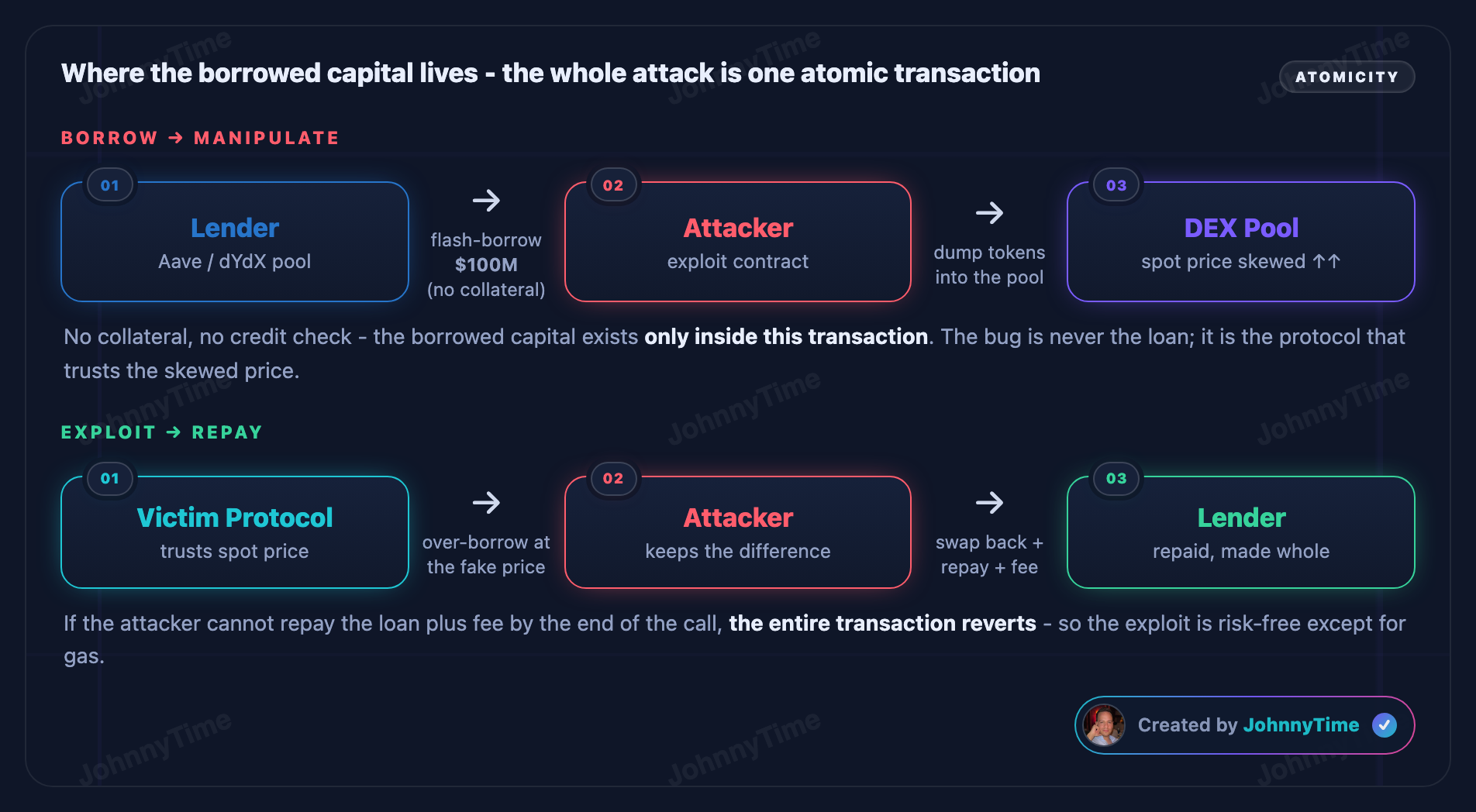
The attacker borrows capital, changes the state a vulnerable protocol trusts, extracts value, and repays the loan before the transaction ends. If repayment fails, the entire transaction reverts.
This guide explains the attack flow, the bZx, Harvest Finance, and Euler Finance examples, the vulnerable Solidity patterns, and the audit checks that prevent flash-loan-amplified exploits.
What exactly is a flash loan attack?
A flash loan attack is one transaction that borrows capital with no collateral, spends it to push a number the victim contract trusts - a pool price, a share price, a vote tally - into a range the code never expected, takes the profit, and pays the loan back before the transaction closes.
The craziest part? The entire attack executes in a matter of seconds. If any step along the way fails, the blockchain automatically reverts the entire sequence. The hacker loses nothing but a few dollars in gas fees.
The "unlimited capital" problem
Think of it like this: imagine being able to borrow $100 million from a bank, manipulate a stock price, profit from the manipulation, and return the money - all before the bank even blinks.
That's exactly what flash loans enable. The lending pool never asks for collateral or approval; the only requirement is that the money comes back before the transaction ends.
Flash loans began as an elegant tool for capital-efficient arbitrage. They have since funded exploits accounting for over $500 million in protocol losses.
Watch: flash loan attacks explained

How flash loans work
Flash loans are uncollateralized loans that must be borrowed and repaid within the same blockchain transaction.
The mechanics are simple:
-
Borrow any amount available in the lending pool
-
Use the funds however you want
-
Repay the full amount plus a small fee
-
If you can't repay, the entire transaction reverts
Platforms like Aave, dYdX, and Uniswap V2 offer flash loans. They were designed for legitimate use cases: arbitrage, collateral swaps, and debt refinancing.
But attackers realized something powerful: with unlimited capital and atomic execution, they could manipulate prices and exploit protocols with zero risk.
What auditors should review for flash loan risk
When auditing a DeFi protocol, ask where temporary capital could change what the protocol believes:
-
Map every price dependency. Flag reads from DEX spot reserves, pool balances, LP token prices, vault
pricePerShare(), AMMslot0(), or any same-block market signal. -
Check collateral valuation. If a borrowed asset can inflate collateral value, share value, or liquidity accounting within one transaction, assume it will be tried.
-
Review liquidation math. Liquidation thresholds, health factors, and bonus calculations should be resilient to single-block price movement.
-
Inspect governance snapshots. Vote power based on current balances can be borrowed, used, and returned in one transaction unless snapshots or delays exist.
-
Test donation and share-inflation paths. Direct transfers, reserve donations, rounding, and exchange-rate updates can become flash-loan-powered accounting attacks.
-
Validate oracle defenses. Prefer external oracle feeds, TWAP windows, staleness checks, deviation limits, and circuit breakers over raw pool reads.
-
Model multi-protocol composition. The exploit may depend on borrowing from one protocol, manipulating a second, and draining a third.
If the attack path depends on price movement, review the oracle manipulation guide. If it depends on callbacks or external calls during accounting updates, review reentrancy attacks as well. To turn this into a working review process, use the smart contract audit checklist while mapping each assumption.
Why flash loan attacks are dangerous
Flash-loan-assisted attacks have caused large losses across DeFi:
| Attack | Year | Impact |
|---|---|---|
| Euler Finance | 2023 | $197M stolen |
| Cream Finance | 2021 | $130M drained |
| Harvest Finance | 2020 | $34M stolen |
| bZx Protocol | 2020 | Multiple attacks, millions lost |
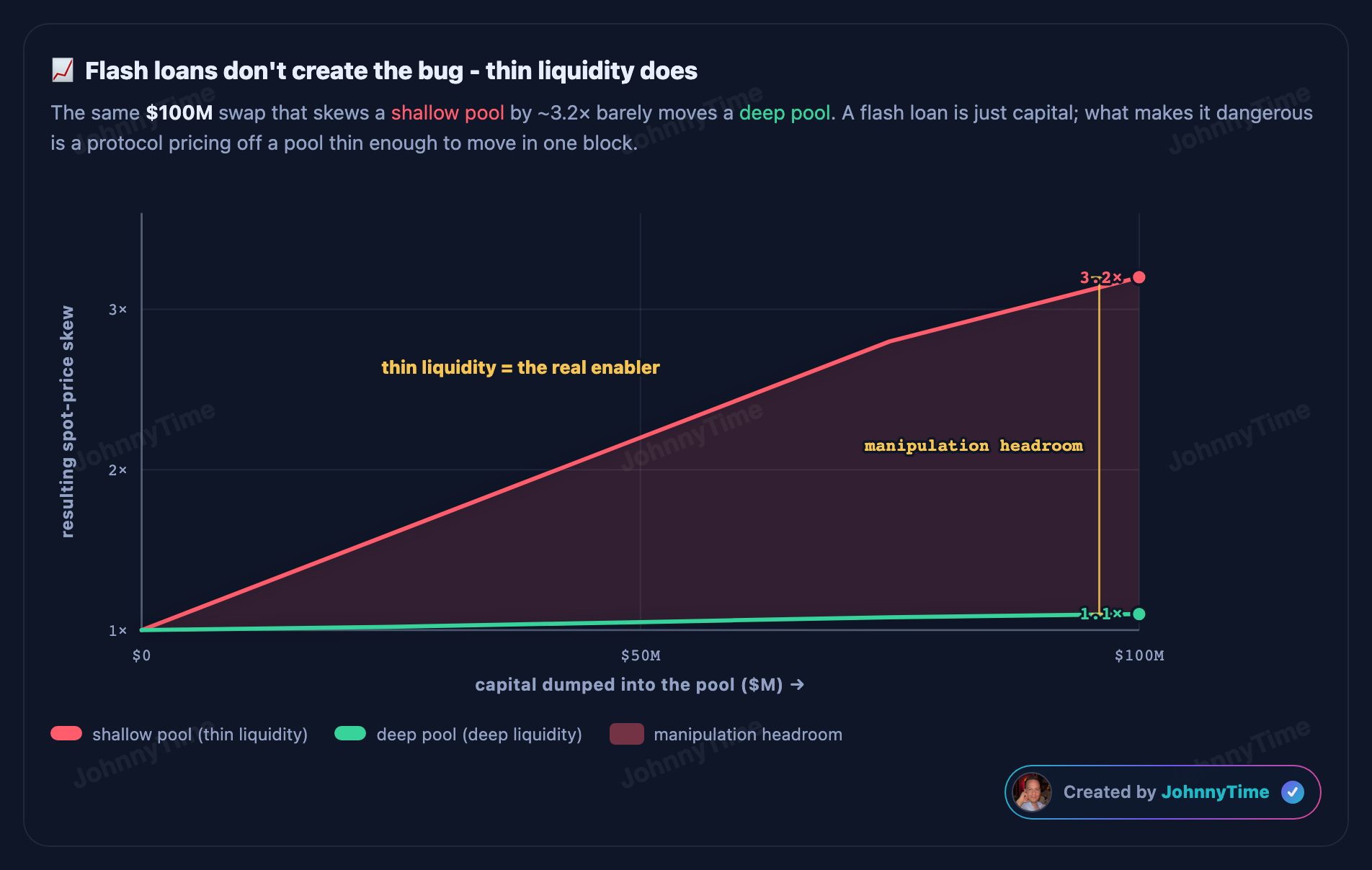
In each of those cases the protocol was reading a data source an attacker could move inside a single block. The flash loan only paid for the move.
Why attackers love flash loans
-
Zero capital required - borrow millions with no collateral
-
Risk-free execution - if the attack fails, you only lose gas fees
-
Single transaction - no trace until the exploit is complete
-
Temporary size - move prices with borrowed capital
-
Repeatable - execute the same attack dozens of times
Real-world flash loan attack examples
Flash loan attacks have drained hundreds of millions of dollars from DeFi protocols.
Euler Finance attack (March 2023) - $197 million
The Euler Finance exploit ranks as the 6th largest DeFi hack in history. On March 13, 2023, an attacker exploited a subtle vulnerability in Euler's donation mechanism.
Attack mechanics:
-
Euler managed lending via eTokens (collateral) and dTokens (debt)
-
The attacker exploited the
donateToReservesfunction from EIP-14 -
This function allowed donating eTokens without checking position health
-
Using two contracts, the attacker created bad debt and acted as liquidator
-
Flash-loaned funds created a large, underwater position
Final haul: 86k ETH ($134.6M), 849 WBTC ($18.6M), $34M USDC, $8.9M DAI
Euler's TVL collapsed from $264 million to $10 million overnight. The EUL token fell 50%. Cascading effects hit Angle Protocol ($17M), Balancer ($11.9M), and Temple DAO ($5M).
Harvest Finance attack (October 2020) - $34 million
The Harvest Finance attack set the template for future flash loan exploits. An anonymous attacker drained $34 million in just seven minutes.
Attack mechanics:
-
Borrowed $50 million USDT via flash loan from Uniswap
-
Swapped $11.4 million USDC to USDT on Curve, pumping USDT price
-
Deposited $60.6 million USDT into Harvest's vault at inflated price
-
Swapped back, crashing USDT price
-
Withdrew $61.1 million USDT at deflated price
-
Repeated this 32 times without prior testing
The attacker could have drained the entire $400 million TVL but chose to stop after $25 million.
bZx flash loan attack (February 2020)
bZx suffered two flash-loan-assisted attacks in February 2020. The best-known path combined borrowed capital, a large market trade, a manipulated on-chain price, and borrowing against the distorted valuation within one transaction.
Attack pattern:
-
Borrow capital without posting collateral for the flash loan
-
Use part of that capital to move a thin on-chain market
-
Let the protocol value collateral or debt from the temporary price
-
Borrow or trade against that distorted value
-
Reverse the market action and repay the flash loan before the transaction ends
The lesson from bZx is not to block a particular lender. Auditors must trace every price and balance assumption across the complete atomic transaction, including integrations outside the protocol being reviewed.
How flash loan attacks work: the anatomy of an exploit
Here is the step-by-step breakdown.
The attack flow
| Step | What Happens | State |
|---|---|---|
| 1 | Attacker borrows temporary capital | Flash loan initiated |
| 2 | Manipulates market prices | DEX reserves skewed |
| 3 | Exploits victim protocol | Overborrowing at false price |
| 4 | Repays and profits | Loan repaid, profit kept |
| 5 | Atomicity protects attacker | If any step fails, all reverts |
Any attacker - regardless of capital - can borrow hundreds of millions to exploit your protocol. If your price oracle can be manipulated in a single transaction, you are vulnerable.
{
  "title": "🎬 Zero capital in, $40M out - and why it all happens in one transaction",
  "stage": { "width": 920, "height": 460 },
  "nodes": [
    { "id": "lender", "label": "Lender", "role": "Aave / dYdX pool", "emoji": "🏦", "color": "blue", "x": 70, "y": 70 },
    { "id": "dex", "label": "DEX Pool", "role": "thin liquidity", "emoji": "💧", "color": "purple", "x": 690, "y": 70 },
    { "id": "attacker", "label": "Attacker", "role": "$0 of own capital", "emoji": "🦹", "color": "red", "x": 380, "y": 210 },
    { "id": "target", "label": "Victim Protocol", "role": "prices collateral", "emoji": "🏛️", "color": "cyan", "x": 690, "y": 350 }
  ],
  "links": [
    { "from": "lender", "to": "attacker" },
    { "from": "attacker", "to": "dex" },
    { "from": "attacker", "to": "target" }
  ],
  "nets": [
    { "id": "atk", "label": "Attacker Net" },
    { "id": "risk", "label": "Attacker's Own Capital Risked" }
  ],
  "legend": [
    { "cls": "token", "label": "value transfer" },
    { "cls": "fail", "label": "reverted / blocked" }
  ],
  "scenarios": {
    "Vulnerable": [
      {
        "note": "The attacker starts with <b>$0</b> of their own capital. The lender's pool is full; the victim prices collateral from a thin DEX pool.",
        "hi": ["attacker"],
        "bal": { "lender": "$100M pool", "attacker": "$0", "dex": "fair price", "target": "healthy" },
        "net": { "atk": "$0", "risk": "$0" }
      },
      {
        "note": "Attacker <b>flash-borrows $100M</b> - no collateral, just a promise to repay before the transaction ends.",
        "hi": ["lender", "attacker"],
        "chip": { "from": "lender", "to": "attacker", "label": "💰 $100M loan", "cls": "token" },
        "bal": { "attacker": "$100M (borrowed)" },
        "net": { "atk": "$0", "risk": "$0" }
      },
      {
        "note": "Dump the $100M into the thin DEX pool, <b>skewing the spot price ~3.2×</b>.",
        "hi": ["attacker", "dex"],
        "chip": { "from": "attacker", "to": "dex", "label": "🔀 swap $100M", "cls": "token" },
        "bal": { "dex": "price ↑↑ 3.2×" },
        "net": { "risk": "$0" }
      },
      {
        "note": "The victim reads the skewed spot price and lets the attacker <b>over-borrow $40M</b> against it.",
        "tone": "bad",
        "hi": ["target", "attacker"],
        "chip": { "from": "target", "to": "attacker", "label": "💸 $40M", "cls": "token" },
        "bal": { "attacker": "$140M held", "target": "-$40M" },
        "net": { "atk": "+$40M", "risk": "$0" }
      },
      {
        "note": "Swap back and <b>repay the $100M loan</b> in the same transaction. The attacker keeps <b>$40M</b> - having risked <b>nothing</b> but gas.",
        "hi": ["attacker", "lender"],
        "chip": { "from": "attacker", "to": "lender", "label": "💰 repay $100M", "cls": "token" },
        "bal": { "attacker": "$40M profit", "lender": "made whole" },
        "net": { "atk": "+$40M", "risk": "$0" }
      }
    ],
    "Fixed (external oracle)": [
      {
        "note": "Same start, but the victim prices collateral from a <b>Chainlink / TWAP</b> feed, not a single block's spot.",
        "hi": ["attacker"],
        "bal": { "lender": "$100M pool", "attacker": "$0", "dex": "spot ≠ oracle", "target": "healthy" },
        "net": { "atk": "$0", "risk": "$0" }
      },
      {
        "note": "Attacker still <b>flash-borrows $100M</b>.",
        "hi": ["lender", "attacker"],
        "chip": { "from": "lender", "to": "attacker", "label": "💰 $100M loan", "cls": "token" },
        "bal": { "attacker": "$100M (borrowed)" },
        "net": { "atk": "$0", "risk": "$0" }
      },
      {
        "note": "The $100M swap still skews the <b>DEX spot</b> price for one block.",
        "hi": ["attacker", "dex"],
        "chip": { "from": "attacker", "to": "dex", "label": "🔀 swap $100M", "cls": "token" },
        "bal": { "dex": "spot ↑↑ (ignored)" },
        "net": { "risk": "$0" }
      },
      {
        "note": "The oracle is time-weighted - <b>one block can't move it</b>. Collateral is valued correctly and the over-borrow is <b>rejected</b>.",
        "tone": "ok",
        "hi": ["target"],
        "chip": { "from": "target", "to": "attacker", "label": "⛔ borrow ✗", "cls": "fail" },
        "bal": { "target": "safe", "attacker": "$100M (borrowed)" },
        "net": { "atk": "$0" }
      },
      {
        "note": "With no profit, the attacker <b>cannot repay the loan + fee</b> - so the <b>entire transaction reverts</b>. They lose only gas.",
        "tone": "ok",
        "hi": ["attacker", "lender"],
        "chip": { "from": "attacker", "to": "lender", "label": "↩ revert", "cls": "fail" },
        "bal": { "attacker": "$0 (reverted)", "lender": "untouched" },
        "net": { "atk": "$0", "risk": "~gas only" }
      }
    ]
  }
}
The five phases
The attacker takes a flash loan for millions (e.g., 100,000 ETH) from Aave or dYdX. No collateral required - only repayment before the transaction ends.
Swap the borrowed tokens through a DEX pool. Sufficient volume changes the reserve ratio and moves the spot price.
A victim protocol that checks the DEX's spot price now calculates values incorrectly. The attacker borrows far more than their collateral is actually worth.
Swap stolen funds back, repay the flash loan plus fee, keep the difference. If any step fails, the entire transaction reverts - zero risk for the attacker.
Phase 1: borrow temporary capital The attacker takes out a flash loan for a large amount (e.g., 100,000 ETH) from Aave, dYdX, or Uniswap V2. No collateral required - only repayment before transaction ends.
Phase 2: manipulate market prices The attacker dumps borrowed tokens into a DEX liquidity pool. This volume drastically skews the reserve ratio, causing extreme spot price manipulation.
Phase 3: exploit the victim protocol A victim protocol (lending platform, yield aggregator) that checks that DEX's spot price now calculates values incorrectly. The attacker interacts at the artificial rate.
Phase 4: repay and profit The attacker swaps stolen funds back, repays the flash loan plus fee, and keeps the difference. Profits range from thousands to hundreds of millions.
Phase 5: atomicity keeps the risk low If any step fails, the entire transaction reverts. The attacker only loses gas fees - typically a few hundred dollars.
Want to understand this beyond theory? The Smart Contract Hacking course includes safe lab exercises where you use flash loans to exploit weak oracle and accounting assumptions, then fix the vulnerable design.
Flash loan vulnerable code example
Understanding vulnerable code is the first step to securing your protocols.
This contract is intentionally vulnerable. Never use this pattern in production.
The vulnerable price feed
// VULNERABLE CONTRACT - DO NOT USE IN PRODUCTION
// SPDX-License-Identifier: MIT
pragma solidity ^0.8.0;

interface IUniswapV2Pair {
    function getReserves() external view returns (uint112 reserve0, uint112 reserve1, uint32 blockTimestampLast);
}

contract VulnerableCollateralEngine {
    IUniswapV2Pair public uniswapPair;

    constructor(address _pair) {
        uniswapPair = IUniswapV2Pair(_pair);
    }

    // CRITICAL VULNERABILITY: Relies on instant spot price from a single DEX pair
    // An attacker can use a flash loan to inject temporary capital and skew reserves
    function getTokenPrice() public view returns (uint256) {
        (uint112 reserve0, uint112 reserve1, ) = uniswapPair.getReserves();

        // EXPLOIT SCENARIO:
        // 1. Attacker flash borrows 100,000 Token0
        // 2. Dumps all 100,000 Token0 into this pair
        // 3. reserve0 increases dramatically, reserve1 barely changes
        // 4. Price = reserve1/reserve0 crashes to near-zero
        // 5. Attacker can now over-borrow from any protocol using this price feed
        return (uint256(reserve1) * 1e18) / uint256(reserve0);
    }
}
Why this code is dangerous
The problem is the data source:
-
Single point of failure - Relies on one DEX's liquidity pool
-
No time-weighting - Vulnerable to instantaneous manipulation
-
No validation - Accepts any price without sanity checks
-
Atomic exploitation - Attacker can manipulate and exploit in same transaction
Flash loan attacker contract example
Here's how an attacker exploits vulnerable price feeds.
// ATTACKER CONTRACT - Educational purposes only
// SPDX-License-Identifier: MIT
pragma solidity ^0.8.0;

interface IFlashLoanProvider {
    function flashLoan(uint256 amount) external;
}

interface IVictimProtocol {
    function borrow(uint256 amount) external;
}

interface IUniswapV2Router {
    function swapExactTokensForTokens(
        uint amountIn,
        uint amountOutMin,
        address[] calldata path,
        address to,
        uint deadline
    ) external returns (uint[] memory amounts);
}

contract FlashLoanAttacker {
    IVictimProtocol public victimProtocol;
    IUniswapV2Router public router;
    IFlashLoanProvider public flashLoanProvider;
    address public tokenA;
    address public tokenB;

    constructor(
        address _victim,
        address _router,
        address _flashLoan,
        address _tokenA,
        address _tokenB
    ) {
        victimProtocol = IVictimProtocol(_victim);
        router = IUniswapV2Router(_router);
        flashLoanProvider = IFlashLoanProvider(_flashLoan);
        tokenA = _tokenA;
        tokenB = _tokenB;
    }

    // STEP 1: Initiate attack - attacker only pays gas fees
    function initiateAttack(uint256 loanAmount) external {
        flashLoanProvider.flashLoan(loanAmount);
    }

    // STEP 2: Flash loan callback - all attack logic executes here
    function executeOperation(uint256 amountBorrowed) external {

        // STEP 2A: PRICE MANIPULATION
        // Dump borrowed tokens into DEX to crash price
        address[] memory path = new address[](2);
        path[0] = tokenA;
        path[1] = tokenB;

        uint256[] memory amounts = router.swapExactTokensForTokens(
            amountBorrowed,
            0,  // Accept any return (no slippage protection)
            path,
            address(this),
            block.timestamp
        );

        // STEP 2B: EXPLOIT VICTIM PROTOCOL
        // Victim reads crashed price from manipulated DEX
        // Attacker borrows far more than they should
        victimProtocol.borrow(100 ether);

        // STEP 2C: RESTORE PRICE & REPAY
        path[0] = tokenB;
        path[1] = tokenA;

        router.swapExactTokensForTokens(
            amounts[1],
            0,
            path,
            address(this),
            block.timestamp
        );

        // STEP 2D: REPAY FLASH LOAN
        // Return borrowed amount + fee, keep the stolen funds
        // IERC20(tokenA).transfer(address(flashLoanProvider), amountBorrowed + fee);
    }

    function withdrawProfit() external {
        // Transfer stolen funds to attacker's wallet
    }
}
Attack execution summary
-
Call
initiateAttack()with the loan amount (e.g., 100,000 ETH) -
The flash loan provider calls back into
executeOperation() -
Swap a large amount on the DEX to lower Token A's spot price
-
Exploit the victim protocol at the manipulated price
-
Swap back to restore the price and repay the flash loan
-
Keep the difference
Atomicity is what makes this cheap to attempt: if any step fails, the whole transaction reverts and the attacker pays only gas.
Ready to write exploits like this yourself? The Smart Contract Hacking course covers flash loans in-depth with real-world scenarios. Learn from JohnnyTime (12+ years in cybersecurity) and Trust (#1 Code4rena warden).
How to prevent flash loan attacks
The fundamental flaw enabling flash loan attacks is using easily manipulable spot prices as price oracles. Here are proven prevention techniques.
1. Decentralized oracle networks (recommended)
Chainlink price feeds are the strongest option here.
Chainlink aggregates prices from multiple off-chain data sources (Coinbase, Binance, Kraken) and delivers them on-chain through a decentralized network of node operators.
Why Chainlink resists flash loan manipulation:
-
Price data sourced from high-liquidity CEXs (impossible to manipulate)
-
Multiple independent node operators provide redundancy
-
Updates based on deviation thresholds, not block-by-block
-
Even if an attacker manipulates one DEX, Chainlink price remains unaffected
2. Time-weighted average price (TWAP)
TWAP calculates the average price over a specific time period (typically 10-30 minutes).
While an attacker can manipulate spot price for one block, maintaining manipulated prices over 30 minutes becomes prohibitively expensive.
3. Circuit breakers and price bounds
Implement sanity checks that reject prices outside reasonable bounds.
If a price moves more than X% from the last known value, pause operations until manual review.
4. Multiple oracle sources
Use multiple price feeds and take the median or reject outliers.
If one source is compromised, the others provide safety.
What it does: Aggregates prices from 50+ exchanges via decentralized node operators. Prices cannot be manipulated by single-transaction DEX swaps.
When to use: Any production protocol handling significant TVL. This is the gold standard.
Limitation: Not all tokens have Chainlink feeds. Requires LINK tokens for operation.
What it does: Calculates average price over a time period. Maintaining manipulation for 30 minutes is prohibitively expensive due to arbitrageurs.
When to use: When Chainlink feeds aren't available for the token pair.
Limitation: Less responsive to real market movements. Requires sufficient pool liquidity.
What it does: Reads current reserve ratio from a single DEX pool - trivially manipulable within one transaction.
When to use: NEVER in production. This is the root cause of almost every flash loan attack.
Limitation: Attackers can manipulate and exploit in the same atomic transaction with zero capital risk.
Oracle security comparison
| Oracle Type | Flash Loan Resistant | Cost | Best For |
|---|---|---|---|
| Chainlink | Excellent | Medium | Production protocols |
| TWAP (30min) | Good | Low | Medium-risk applications |
| Single DEX spot | Vulnerable | Very Low | NEVER USE |
| Multi-oracle | Excellent | High | Critical infrastructure |
Single DEX Spot Price
Reading getReserves() from one pool is trivially manipulable. Every major flash loan attack exploited this exact pattern. Never use in production.
TWAP Oracle Only
Time-weighted average prices resist single-block manipulation but require sufficient pool liquidity and can lag behind real market movements.
Chainlink + Circuit Breakers
Decentralized oracle feeds with staleness checks, price deviation limits, and multi-oracle validation provide production-grade flash loan resistance.
Quick reference: flash loan attack prevention checklist
Before deploying any DeFi protocol:
-
Never use single DEX spot prices for critical price calculations
-
Use Chainlink oracles or other decentralized oracle networks
-
Implement TWAP (30+ minute windows) if using on-chain oracles
-
Add circuit breakers that pause on suspicious price movements
-
Validate price freshness with staleness checks
-
Get professional audits focused on oracle manipulation vectors
-
Monitor on-chain activity for unusual price movements
-
Implement emergency pause functionality
Flash loan secure code example
The following example uses a Chainlink price feed. Production use also requires feed-specific freshness, decimal, and failure checks.
// DEFENSIVE EXAMPLE - adapt and audit before production use
// SPDX-License-Identifier: MIT
pragma solidity ^0.8.0;

import "@chainlink/contracts/src/v0.8/interfaces/AggregatorV3Interface.sol";

contract SecureCollateralEngine {
    AggregatorV3Interface internal priceFeed;

    uint256 public constant MAX_PRICE_AGE = 1 hours;

    event PriceChecked(int256 price, uint256 timestamp);

    /**
     * @notice Initialize with Chainlink price feed address
     * @dev Different networks have different feed addresses
     *
     * Ethereum Mainnet - ETH/USD: 0x5f4eC3Df9cbd43714FE2740f5E3616155c5b8419
     * Polygon - ETH/USD: 0xF9680D99D6C9589e2a93a78A04A279e509205945
     * Arbitrum - ETH/USD: 0x639Fe6ab55C921f74e7fac1ee960C0B6293ba612
     */
    constructor(address _priceFeed) {
        require(_priceFeed != address(0), "Invalid price feed");
        priceFeed = AggregatorV3Interface(_priceFeed);
    }

    /**
     * @notice Get latest price from Chainlink oracle
     * @dev This price CANNOT be manipulated by flash loans because:
     *      1. Data sourced from CEXs (Binance, Coinbase, Kraken)
     *      2. Aggregated from multiple independent node operators
     *      3. Updated based on deviation thresholds, not per-block
     */
    function getLatestPrice() public view returns (int256) {
        (
            uint80 roundID,
            int256 price,
            /* uint256 startedAt */,
            uint256 timeStamp,
            uint80 answeredInRound
        ) = priceFeed.latestRoundData();

        // SECURITY VALIDATIONS

        // 1. Ensure price is positive
        require(price > 0, "Invalid price: negative or zero");

        // 2. Ensure price data is fresh
        require(timeStamp > 0, "Round not complete");
        require(block.timestamp - timeStamp <= MAX_PRICE_AGE, "Stale price data");

        // 3. Ensure the round was answered
        require(answeredInRound >= roundID, "Stale round");

        return price;
    }

    /**
     * @notice Calculate collateral value safely
     */
    function getCollateralValue(uint256 collateralAmount) public view returns (uint256) {
        int256 price = getLatestPrice();
        return (collateralAmount * uint256(price)) / 1e18;
    }

    /**
     * @notice Check if borrower is safely collateralized
     */
    function isSafelyCollateralized(
        uint256 borrowAmount,
        uint256 collateralAmount,
        uint256 minCollateralRatio
    ) public view returns (bool) {
        uint256 collateralValue = getCollateralValue(collateralAmount);
        uint256 actualRatio = (collateralValue * 100) / borrowAmount;
        return actualRatio >= minCollateralRatio;
    }
}
Security features at a glance
| Feature | Protection |
|---|---|
| Chainlink integration | Flash loan resistant prices |
| Staleness checks | Rejects outdated data |
| Round validation | Ensures complete oracle rounds |
| Positive price check | Prevents invalid calculations |
Aave, Compound, MakerDAO, and most other large DeFi protocols price collateral this way.
These patterns separate junior developers from senior security researchers. The Smart Contract Hacking course covers flash loans, oracle manipulation, and 20+ other attack vectors alongside defensive techniques. Join 2,000+ security researchers in our Discord community.
Common misconceptions
"Flash loans are the vulnerability."
Tap to revealFlash loans are a legitimate DeFi tool. The real vulnerability is protocols that rely on easily manipulable price sources. Fix the oracle, and flash loans become irrelevant to security.
"If the attack fails, the attacker loses everything."
Tap to revealIf any step fails, the entire transaction reverts. The attacker only loses the gas fee - typically a few hundred dollars. Flash loan attacks are essentially risk-free.
"Chainlink feeds cannot be manipulated."
Tap to revealNo successful Chainlink manipulation has occurred in production. An attacker would need to control a majority of decentralized nodes AND manipulate prices across dozens of exchanges simultaneously.
"Flash loan attacks only happen on Ethereum mainnet."
Tap to revealFlash loan attacks occur on any chain with DeFi liquidity - BSC, Polygon, Arbitrum, Avalanche, and all major EVM-compatible networks.
Related vulnerabilities
Flash loans are rarely the vulnerability themselves. They amplify oracle manipulation attacks by funding DEX trades that move a price source trusted by another protocol. Harvest Finance and Cream Finance both involved this combination.
Flash loans can also enable reentrancy attacks by providing the initial capital needed to deposit into vulnerable protocols and trigger recursive withdrawals. In sophisticated multi-step exploits, flash loans fund the entire attack chain while guaranteeing the attacker risks nothing but gas fees.
Test your flash loan knowledge
5 questions - How well do you understand this attack vector?
Flash loan attack FAQ
A flash loan attack is when someone borrows millions of dollars, manipulates prices, exploits a vulnerable protocol, and repays the loan - all in a single transaction lasting seconds. If anything fails, they only lose gas fees.
Over $500 million has been stolen through flash loan exploits since 2020. The Euler Finance attack alone accounted for $197 million.
Yes! Use decentralized oracles like Chainlink instead of single DEX spot prices. Implement TWAP oracles, circuit breakers, and multi-oracle validation for defense in depth.
No. Flash loans are a legitimate DeFi primitive. They become dangerous when a protocol assumes attackers cannot access substantial capital for one transaction. The vulnerability is usually weak oracle design, manipulable accounting, unsafe governance snapshots, or fragile liquidation math.
Auditors first look for same-block assumptions: DEX spot prices, current balances used as voting power, vault share prices that can be inflated, and liquidation math that reacts immediately to manipulable market state.
Flash loans themselves are legal and legitimate. However, using them to exploit vulnerabilities and steal funds is illegal in most jurisdictions and can be prosecuted as theft or fraud.
Yes. Flash loan attacks can occur on any blockchain with smart contracts and sufficient liquidity - including Arbitrum, Optimism, Polygon, BSC, and all major EVM chains.
What flash loans actually test
A flash loan is a stress test for every assumption a protocol makes about how much capital an attacker can hold for the length of one transaction. If the code assumes nobody can move a market in one block, inflate a share price, or borrow voting power before a snapshot, a flash loan invalidates that assumption for a few hundred dollars of gas.
Before deployment, review:
-
same-block price dependencies,
-
vault share and LP token accounting,
-
liquidation and collateral valuation paths,
-
donation, rounding, and reserve-manipulation paths,
-
oracle fallback behavior during stress.
The safest auditors do more than recognize the pattern. They write the exploit, confirm the invariant failure, and then prove the fix blocks the same path.
The Smart Contract Hacking course teaches flash loan attacks through hands-on labs alongside oracle manipulation, reentrancy, access control, and other high-impact vulnerability classes.
You can browse the full curriculum or try a free lesson before deciding whether the full course is the right fit.
References
Practice smart contract security
Build your auditing skills with guided exploit exercises in the Smart Contract Hacking course.

Start your free security training
Get 25 free lessons and 4 guided exploit exercises.
Onboarding details by email within 2–3 business days.